When to Upgrade From a Single-Needle to a Multi-Needle Embroidery Machine
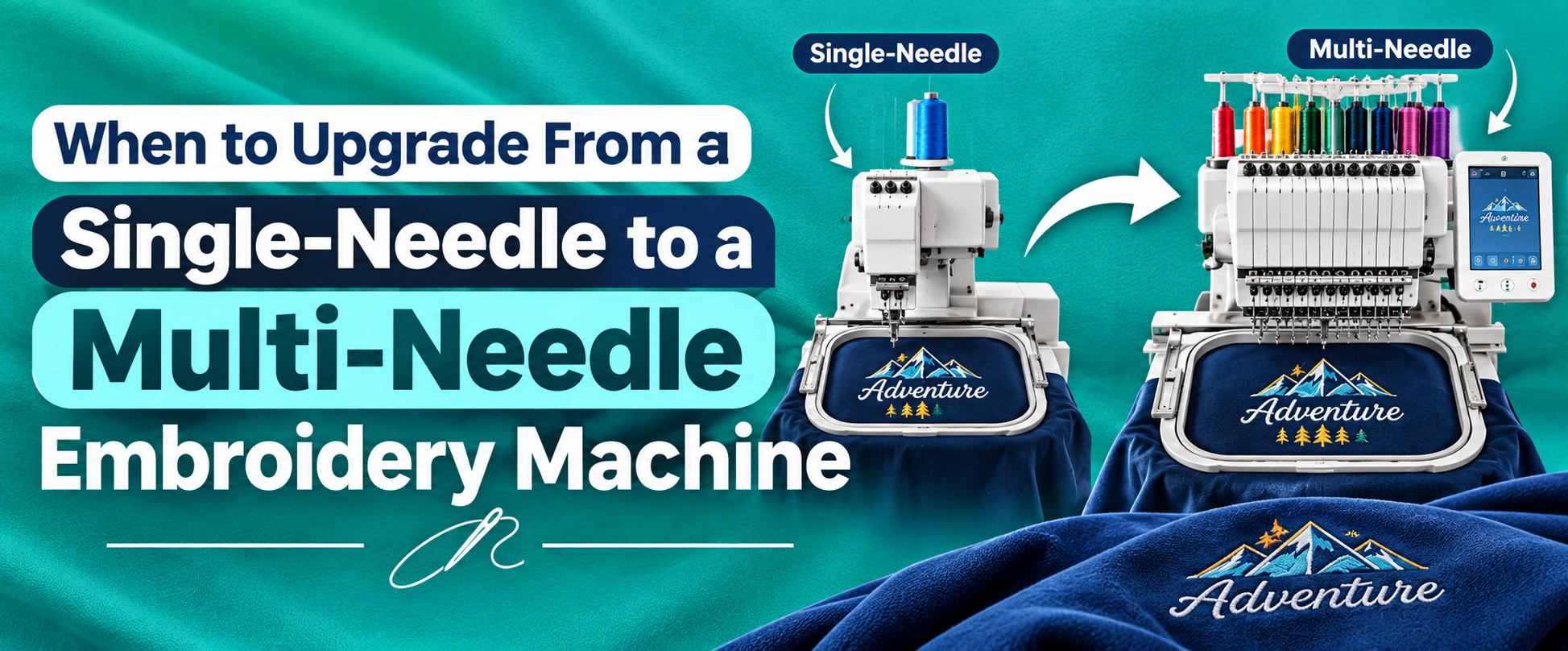
Last week you turned down an order and told yourself it was a one-time thing. It wasn’t. A business that outgrows its machine says no a little more every month, and the lost money never shows up on a statement.
Most advice on a multi needle embroidery machine for beginners reads like a catalog page. This guide works differently. It starts with signs you spot at your own bench, adds a weekly volume benchmark and a break-even check, and covers multi-needle machines for startups that watch every dollar.
Clear Signs Your Single-Needle Machine Is Holding Your Business Back
3 signs show up first. Recognize two of them, and the upgrade conversation is already overdue.
You’re saying no to orders because of machine limits
This one is the loudest. You turn away caps, jacket backs, large designs, and anything over a few dozen pieces, because the machine says no before you do. Many home models stop at a hoop around 5" x 7", which rules out big back designs.
Keep a simple tally for one month. Write down every order you decline and its dollar value. Look for patterns like these:
Caps and structured hats
Jacket backs and large designs
Batches of 25 pieces or more
Rush jobs with short deadlines
If the tally tops what a month of machine payments would cost, the machine is already costing you money.
You spend more time changing thread than stitching
Time one real order with a stopwatch. Take a 4,000-stitch logo with six colors. At about 650 stitches per minute, the machine stitches for roughly six minutes. Five manual color changes at a minute each add another five. Nearly half your time at the machine goes to thread, not embroidery.
That ratio gets worse with more colors. Eight colors mean seven swaps, and every swap is another chance for a snag, a wrong spool, or a missed trim. When your hands spend more time on thread than on garments, the machine has stopped being a tool and become a chore.
Your turnaround times are costing you repeat customers
Late orders rarely start a fight. Customers just stop reordering, and you notice it in the numbers months later.
Watch for these:
You quote two weeks while nearby shops quote five days
You miss a promised date more than once a quarter
Regular clients place smaller or fewer orders
Rush requests go to someone else
Track your on-time rate for 30 days. If fewer than nine of ten orders ship on the promised date, that deserves your attention.
Order Volume Benchmarks: How Many Pieces Per Week Justify an Upgrade?
As a rough benchmark, start pricing a multi-needle machine when you hit 30 to 50 pieces a week on designs with four or more colors, or when you decline work you actually want. It’s a guide, not a law. Color count matters as much as piece count.
Weekly volume | Typical designs | What usually makes sense |
Under 15 pieces | 1 to 3 colors | Stay single-needle |
15 to 30 pieces | 3 to 5 colors | Track time, start saving, watch pre-owned listings |
30 to 50 pieces | 4+ colors | Upgrade to a 6-needle machine |
50+ pieces or regular caps | Any | Upgrade now, 6 or 10 needles |
The point where single-needle labor costs outweigh the machine cost
Think of labor as a bill that arrives every week. Each minute of manual color changes costs you your hourly rate, whether you pay yourself or an employee. Multiply minutes by pieces by rate, and the weekly cost stops looking small. At some volume, the monthly cost of hand labor passes the monthly payment on a new machine. That crossing point is your upgrade point.
A simple break-even check you can do today
Take a calculator and follow these steps:
Find the minutes you spend on color changes per piece.
Multiply by the pieces you stitch each week, then divide by 60 to get hours.
Multiply those hours by your labor cost per hour.
Add the profit from orders you now decline.
Divide the machine’s price by that weekly total.
Here is an example. You stitch 100 pieces a week, save 5 minutes on each, and pay $20 an hour. That’s about 8.3 hours, or roughly $167 a week. Add 40 extra pieces a week at $8 profit each, and you gain another $320. The weekly total hits about $487, so a $15,000 machine pays itself back in roughly 31 weeks.
Notice what carries the weight there. Labor savings alone take about 90 weeks. The extra orders do the heavy lifting, so be honest about which orders you would really win.
Can Your Budget Handle the Upgrade Right Now?
After paying for the machine, do you still have cash for blanks, thread, and the first slow month? If not, wait or buy smaller. A machine without supplies just sits there.
New vs refurbished multi-needle machines
A new machine brings a warranty, dealer training, and current software. Brother lists the PR1055X at $20,799.99. In the pre-owned market, a well-kept 10-needle machine typically lists between $12,000 and $15,000. That gap is real money for a startup, and a used multi needle embroidery machine is a fair way to close it. The catch is risk. Without a warranty, a repair bill, especially an electrical one, sometimes costs more than buying new.
New | Used | |
Price | Highest | Often $12,000 to $15,000 for a 10-needle |
Warranty | Yes | Rarely |
Training and support | Through the dealer | Usually none |
Risk | Low | Higher |
Best for | Shops that need a smooth start | Shops with tight cash and a technician nearby |
Before you pay for a pre-owned machine, check these:
Watch it stitch a full design before any money changes hands.
Ask for service records and the date of the last tune-up.
Listen for grinding, squealing, or a loud clunk when the needle bar changes direction.
Bring a fresh needle and scrap stabilizer for your own test.
Confirm a technician works within driving distance.
Pay a certified technician to inspect the machine before you buy.
Treat prices around 90 percent below normal as a scam signal.
Financing options and how fast the machine pays itself back
Most buyers choose from four paths:
Dealer financing, often bundled with the machine
An equipment loan from a bank or credit union
A lease with a buyout at the end
A business credit card for accessories only
Test every option against the weekly gain from your break-even check. In our example, $487 a week comes to roughly $2,100 a month. A $15,000 machine spread over 36 months works out to about $420 a month before interest. That leaves a comfortable gap. Pick a payment that stays well under your expected monthly gain, and keep extra cash for the slow weeks.
Talk to your accountant about equipment deductions such as Section 179 before you sign. Tax treatment changes the real cost of the machine.
What You Lose by Waiting Too Long to Upgrade
Waiting seems safe. It costs more than most owners count.
Burnout from manual color changes
Repetition wears you down. Standing at a machine for hours, swapping thread every few minutes, drains your energy fast, and tired people make mistakes. Quality slips, you redo garments, and orders you once loved start to look like a burden.
Signs burnout is setting in:
You push designs to the last minute.
You avoid multi-color designs on purpose.
You catch thread and placement errors after the fact.
Weekends disappear into catching up.
Clients moving to faster competitors
Corporate and team buyers compare speed as much as price. Once a client moves to a faster shop, they rarely come back. Think about lifetime value. A client who orders four times a year at $600 each is worth $2,400 a year. Lose three clients like that and you lose more than $7,000 in yearly revenue, roughly half the price of a good pre-owned machine.
What to Check Before You Buy Your First Multi-Needle Machine
Treat this as a checklist, not a shopping spree. Each item saves you from a bad surprise.
Needle count, hoop sizes, and c nb ap frame compatibility
Needle count: Six needles cover most logos. Choose 10 or 15 when designs often pass six colors or you keep specialty threads loaded.
Hoop sizes: Check the maximum field. The PR1055X gives you 8" x 14", which covers left-chest logos and most mid-size designs, while big jacket backs ask for a larger field.
Cap frame: Confirm whether it ships with the machine or costs extra, and which cap heights it fits.
Extra frames: Ask which hoop sizes come standard and which ones you pay for separately.
Space, power, and software requirements
Space: Multi-needle machines are dense and top-heavy, so plan a sturdy table and a second pair of hands for moving it.
Power: Most single-head machines in this class plug into a standard outlet. Confirm the voltage on the spec sheet before delivery.
Software: Check which file formats the machine reads. Brother machines read PES, and many commercial brands read DST. The PR1055X is wireless enabled, which speeds up file transfers.
Digitizing: Decide now whether you digitize in-house or hire a digitizer.
Preparing your digitized files for the switch
Here’s something I learned the hard way. Files built for a slow single-needle machine need a second look. Several of mine had color sequences that jumped back and forth, and the new machine stitched every jump without complaint. Reordering the colors fixed it.
Before delivery day:
Convert your most-used designs to the right format, PES or DST.
Reorder colors to cut needless changes.
Assign each color to a needle and save the chart.
Test stitch every design on scrap fabric.
Label each file with its needle setup so reorders go fast.
FAQs
How do I know it’s time to move to a multi-needle machine?
You decline orders, color changes eat close to half your stitch time, or deadlines slip. Any two of those signs mean it’s time.
Is a 6-needle or 10-needle machine better for a growing shop?
Six needles fit most logos and cost less. Pick ten when you regularly pass six colors or want spare needles loaded with specialty thread.
Can I keep my single-needle machine after upgrading?
Yes. Many shops keep it for samples, test stitch-outs, and as a backup when the main machine goes down.
How long does it take to learn a multi-needle machine?
Expect about 30 days to stitch comfortably and a few months to master caps and tricky fabrics.
Author Bio
Matthew Davis
Senior Embroidery Digitizer
I'm Matthew Davis, a skilled embroidery digitizer with more than 15 years of practical experience. I specialize in logo digitizing, 3D puff embroidery designs, applique digitizing, custom embroidery digitizing, and working with difficult fabrics. Over the years, I have worked with different fashion brands and production teams worldwide. I always share simple tips and useful techniques to help both beginners and businesses improve their embroidery work.