Tokenization in Transformers v5: Simpler, Clearer, and More Modular
Transformers v5 redesigns how tokenizers work. The big tokenizers reformat separates tokenizer design from trained vocabulary (much like how PyTorch separates neural network architecture from learned weights). The result is tokenizers you can inspect, customize, and train from scratch with far less friction.
TL;DR: This blog explains how tokenization works in Transformers and why v5 is a major redesign, with clearer internals, a clean class hierarchy, and a single fast backend. It’s a practical guide for anyone who wants to understand, customize, or train model-specific tokenizers instead of treating them as black boxes.
Table of Contents
For experts: If you're already familiar with the concepts and want to understand the changes in v5, go to v5 Separates Tokenizer Architecture from Trained Vocab
Before diving into the changes, let's quickly cover what tokenization does and how the pieces fit together.
What is tokenization?
Language models don't read raw text. They consume sequences of integers usually called token IDs or input IDs. Tokenization is the process of converting raw text into these token IDs. (Try the tokenization playground here to visualize tokenization.)
Tokenization is a broad concept used across natural language processing and text processing generally. This post focuses specifically on tokenization for Large Language Models (LLMs) using the transformers and tokenizers libraries.
from transformers import AutoTokenizer
tokenizer = AutoTokenizer.from_pretrained("HuggingFaceTB/SmolLM3-3B")

text = "Hello world"
tokens = tokenizer(text)

print(tokens["input_ids"])
# [9906, 1917]

print(tokenizer.convert_ids_to_tokens(tokens["input_ids"]))
# ['Hello', 'Ġworld']
Ġworld(above) is a single token that represents the character sequence " world" (with the space).
A token is the smallest string unit the model sees. It can be a character, word, or subword chunk like "play" or "##ing" ("##" is a pattern, don't worry if you don't completely understand it now 🤗). The vocabulary maps each unique token to the token ID.
from transformers import AutoTokenizer

tokenizer = AutoTokenizer.from_pretrained("HuggingFaceTB/SmolLM3-3B")
print(tokenizer.vocab)

# {'ÎĹÎľ': 106502, 'ĠPeel': 89694, '.languages': 91078, ...}
A good tokenizer compresses text into the smallest amount of tokens. Fewer tokens means more usable context without increasing model size. Training a tokenizer boils down to finding the best compression rules for your datasets. For example, if you work on Chinese corpus you can sometimes find very nice surprises 😉.
The tokenization pipeline
Tokenization happens in stages. Each stage transforms text before passing it to the next:
Stage
Purpose
Example
Normalizer
Standardizes text (lowercasing, unicode normalization, whitespace cleanup)
"HELLO World" → "hello world"
Pre-tokenizer
Splits text into preliminary chunks
"hello world" → ["hello", " world"]
Model
Applies the tokenization algorithm (BPE, Unigram, etc.)
["hello", " world"] → [9906, 1917]
Post-processor
Adds special tokens (BOS, EOS, padding)
[9906, 1917] → [1, 9906, 1917, 2]
Decoder
Converts token IDs back to text
[9906, 1917] → "hello world"
Each component is independent. You can swap normalizers or change the algorithm without rewriting everything else.
You can access the rust based tokenizer through
_tokenizer. We go in more depth about it in this section
from transformers import AutoTokenizer

tokenizer = AutoTokenizer.from_pretrained("google/gemma-3-270m-it")

print(f"{tokenizer._tokenizer.normalizer=}")
# Replace(...)

print(f"{tokenizer._tokenizer.pre_tokenizer=}")
# Split(...)

print(f"{tokenizer._tokenizer.model=}")
# BPE(...)

print(f"{tokenizer._tokenizer.post_processor=}")
# TemplateProcessing(...)

print(f"{tokenizer._tokenizer.decoder=}")
# Sequence(decoders=[Replace(...), ByteFallback(), Fuse()])
Tokenization algorithms
The following algorithms dominate modern language model tokenizers:
Byte Pair Encoding (BPE) iteratively merges the most frequent character pairs. This algorithm is deterministic and widely used. (Read more about BPE)
from transformers import AutoTokenizer

tokenizer = AutoTokenizer.from_pretrained("openai/gpt-oss-20b")
print(tokenizer._tokenizer.model)

# BPE(...)
Unigram takes a probabilistic approach, selecting the most likely segmentation from a large initial vocabulary. This is more flexible than the strict BPE. (Read more about Unigram)
from transformers import AutoTokenizer

tokenizer = AutoTokenizer.from_pretrained("google-t5/t5-base")
print(tokenizer._tokenizer.model)

# Unigram(...)
WordPiece resembles BPE but uses different merge criteria based on likelihood. (Read more about WordPiece)
from transformers import AutoTokenizer

tokenizer = AutoTokenizer.from_pretrained("bert-base-uncased")
print(tokenizer._tokenizer.model)

# WordPiece(...)
Accessing tokenizers through transformers
The tokenizers library is a Rust-based tokenization engine. It is fast, efficient, and completely language model agnostic. The library handles the mechanics of converting text into token IDs and back. The tokenizers library is a general-purpose tool that implements the tokenization algorithms, but does not implement the conventions that connect those algorithms to specific language models.
Consider what happens when you use tokenizers directly with the SmolLM3-3B model:
from tokenizers import Tokenizer

tokenizer = Tokenizer.from_pretrained("HuggingFaceTB/SmolLM3-3B")
text = "Hello world"
encodings = tokenizer.encode(text)

print(encodings.ids)
# [9906, 1917]
print(encodings.tokens)
# ['Hello', 'Ġworld']
The output is raw tokenization. You get token IDs and the string pieces they correspond to. Nothing more.
Now consider what's missing. The SmolLM3-3B is a conversational model. When you interact with it, you typically structure your input as a conversation with roles like "user" and "assistant". The language model expects special formatting tokens to indicate these roles. The raw tokenizers library has no concept of any of this.
How do you bridge the gap between raw tokenization and model requirements?
The transformers library bridges this gap. The library is primarily known as a model definition library, but it also provides a tokenizer abstraction layer that wraps the raw tokenizers backend and adds model-aware functionality.
Here's the same tokenization with the transformers wrapper:
from transformers import AutoTokenizer

tokenizer = AutoTokenizer.from_pretrained("HuggingFaceTB/SmolLM3-3B")

# Format a conversation using the model's chat template
prompt = "Give me a brief explanation of gravity in simple terms."
messages = [{"role": "user", "content": prompt}]
text = tokenizer.apply_chat_template(
    messages,
    tokenize=False,
    add_generation_prompt=True,
)

print(text)

# <|im_start|>system
# ...
# <|im_start|>user
# Give me a brief explanation of gravity in simple terms.<|im_end|>
# <|im_start|>assistant

model_inputs = tokenizer([text], add_special_tokens=False, return_tensors="pt")
Notice how the special tokens like <|im_start|> and <|im_end|> are applied to the prompt before tokenizing. This is useful for the model to learn where a new sequence starts and ends.
The transformers tokenizer adds everything the raw library lacks:
Chat template application. The
apply_chat_templatemethod formats conversations according to the model's expected format, inserting the correct special tokens and delimiters.Automatic special token insertion. Beginning-of-sequence and end-of-sequence tokens are added where the model expects them.
Truncation to context length. You can specify
truncation=Trueand the tokenizer will respect the model's maximum sequence length.Batch encoding with padding. Multiple inputs can be padded to the same length with the correct padding token and direction.
Return format options. You can request PyTorch tensors (
return_tensors="pt"), NumPy arrays and others.
transformersimplements the tokenization API that is most commonly used in the entire ML community (encode,decode,convert_tokens_to_ids, etc.)
The tokenizer class hierarchy in transformers
The transformers library organizes tokenizers into a class hierarchy. At the top sits a base class that defines the common interface. Below it, backend classes handle the actual tokenization using different engines. At the bottom, model-specific classes configure the backends for particular models.
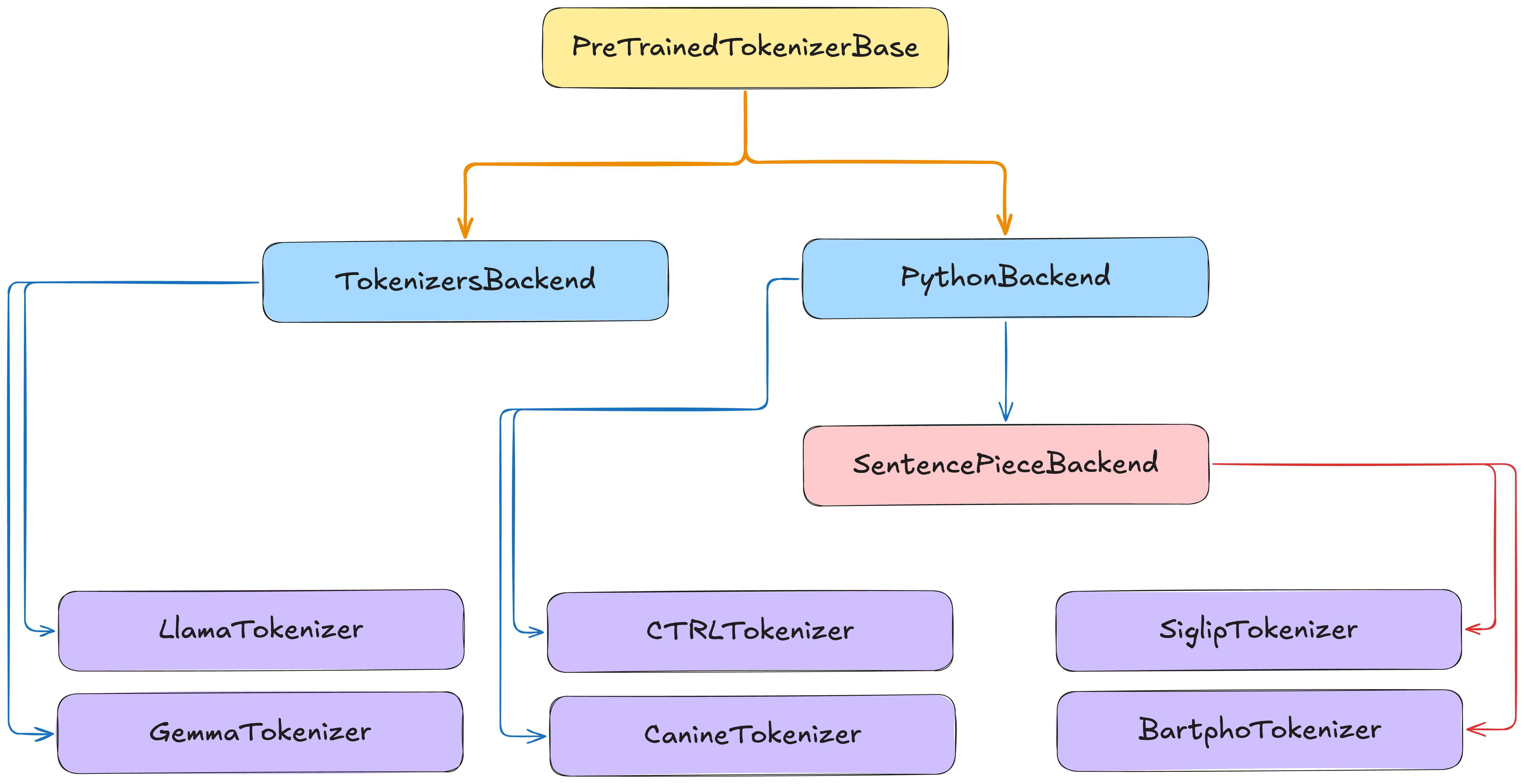
The class hierarchy for tokenizers inside transformers
PreTrainedTokenizerBase defines the common interface for all tokenizers
PreTrainedTokenizerBase is the abstract base class for all tokenizers in transformers. It defines the interface that every tokenizer must implement.
The base class handles functionality that doesn't depend on the tokenization backend:
Special token properties. Properties like
bos_token,eos_token,pad_token, andunk_tokenare defined here. These properties provide access to the special tokens that models use to mark sequence boundaries and handle unknown inputs.Encoding interface. The
__call__method,encode, andencode_plusmethods are defined here. These methods accept text input and return token IDs along with attention masks and other metadata.Decoding interface. The
decodeandbatch_decodemethods convert token IDs back to text.Serialization. The
save_pretrainedandfrom_pretrainedmethods handle downloading the correct files, reading information, saving tokenizers to disk etc.Chat template support. The
apply_chat_templatemethod lives here, formatting conversations according to Jinja templates stored in the tokenizer configuration.
Every tokenizer in transformers ultimately inherits from PreTrainedTokenizerBase. The base class ensures consistent behavior across all tokenizers, regardless of which backend they use for the actual tokenization.
TokenizersBackend wraps the tokenizers library
TokenizersBackend is the primary backend class for most modern tokenizers. It inherits from PreTrainedTokenizerBase and wraps the Rust-based tokenizers library.
The class stores the Rust tokenizer object internally:
class TokenizersBackend(PreTrainedTokenizerBase):
    def __init__(self, tokenizer_object, ...):
        self._tokenizer = tokenizer_object  # The Rust tokenizer
        ...
When you call encoding methods on a TokenizersBackend tokenizer, the class delegates the actual tokenization to the Rust backend:
def _batch_encode_plus(self, batch_text_or_text_pairs, ...):
    encodings = self._tokenizer.encode_batch(batch_text_or_text_pairs, ...)
    ...
The Rust backend performs computationally intensive work, while the Python wrapper adds the model-aware features on top.
Many model-specific tokenizers inherit from TokenizersBackend, examples include:
LlamaTokenizerGemmaTokenizer
These model-specific classes configure the backend with the correct vocabulary, merge rules, special tokens, and normalization settings for their respective models.
PythonBackend provides a pure-Python mixin
PythonBackend inherits from PreTrainedTokenizerBase and implements tokenization in pure Python. The class is aliased as PreTrainedTokenizer.
The pure-Python backend exists for several reasons:
Custom tokenization logic. Some models require tokenization behavior that doesn't fit the standard
tokenizerspipeline.Legacy compatibility. Older model implementations may rely on Python-specific behavior.
The Python backend is slower than the Rust backend. For most use cases, the Rust-backed
TokenizersBackendis preferred.
Model-specific tokenizers that inherit from PythonBackend (or its alias PreTrainedTokenizer) include some older or specialized models, like:
CTRLTokenizerCanineTokenizer
SentencePieceBackend handles SentencePiece models
SentencePieceBackend inherits from PythonBackend and provides integration with Google's SentencePiece library. SentencePiece is a standalone tokenization library that many models use, particularly those trained by Google.
The backend wraps a SentencePiece processor:
class SentencePieceBackend(PythonBackend):
    def __init__(self, vocab_file, ...):
        self.sp_model = spm.SentencePieceProcessor()
        self.sp_model.Load(vocab_file)
        ...
Models that use SentencePiece tokenization inherit from this backend. Examples include:
SiglipTokenizerBartphoTokenizer
The SentencePiece backend inherits from PythonBackend rather than directly from PreTrainedTokenizerBase because it shares much of the same interface and padding/truncation logic.
AutoTokenizer automatically selects the correct tokenizer class
AutoTokenizer is the recommended entry point for loading tokenizers. It automatically determines which tokenizer class to use for a given model and returns an instance of that class.
from transformers import AutoTokenizer

tokenizer = AutoTokenizer.from_pretrained("gpt2")
Behind the scenes, AutoTokenizer performs these steps:
Download the tokenizer configuration. The
from_pretrainedmethod fetchestokenizer_config.jsonfrom the Hub (or from a local directory).Identify the model type. The configuration contains metadata that identifies the model type (e.g., "gpt2", "llama", "bert").
Look up the tokenizer class.
AutoTokenizermaintains a mapping calledTOKENIZER_MAPPING_NAMESthat maps model types to tokenizer class names:
TOKENIZER_MAPPING_NAMES = {
    "gpt2": "GPT2Tokenizer",
    "llama": "LlamaTokenizer",
    "bert": "BertTokenizer",
    ...
}
Instantiate the correct class.
AutoTokenizerimports the appropriate tokenizer class and calls itsfrom_pretrainedmethod.Return the configured tokenizer. You receive a fully configured, model-specific tokenizer ready for use.
The benefit of
AutoTokenizeris that you don't need to know which tokenizer class a model uses. Whether a model usesLlamaTokenizer,GPT2Tokenizer, orBertTokenizer, the sameAutoTokenizer.from_pretrained("model-name")call works.
The tokenizer system in transformers forms a layered architecture:
Layer
Component
Responsibility
Entry Point
AutoTokenizer
Automatically selects and instantiates the correct tokenizer class
Model-Specific
LlamaTokenizer, GPT2Tokenizer, etc.
Configures the backend with model-specific architecture of normalizer, pre tokenizer, etc, special tokens, and settings
Backend
TokenizersBackend, PythonBackend, SentencePieceBackend
Implements the actual tokenization using a specific engine
Base
PreTrainedTokenizerBase
Defines the common interface and shared functionality
Engine
tokenizers (Rust), SentencePiece, Pure Python
Performs raw tokenization
v5 Separates Tokenizer Architecture from Trained Vocab
The most significant change in Transformers v5 is a philosophical shift in how tokenizers are defined. Tokenizers now work like PyTorch's nn.Module: you define the architecture first, then fill it with learned parameters.
The problem with v4: tokenizers were opaque and tightly coupled
In v4, tokenizers were black boxes tied to pretrained checkpoint files. If you loaded LlamaTokenizerFast, you couldn't easily answer basic questions about it:
Is it BPE or Unigram?
How does it normalize text?
What pre-tokenization strategy does it use?
What are the special tokens and their positions?
The __init__ method gave no clues. You had to dig through serialized files or external documentation to understand what the tokenizer actually did.
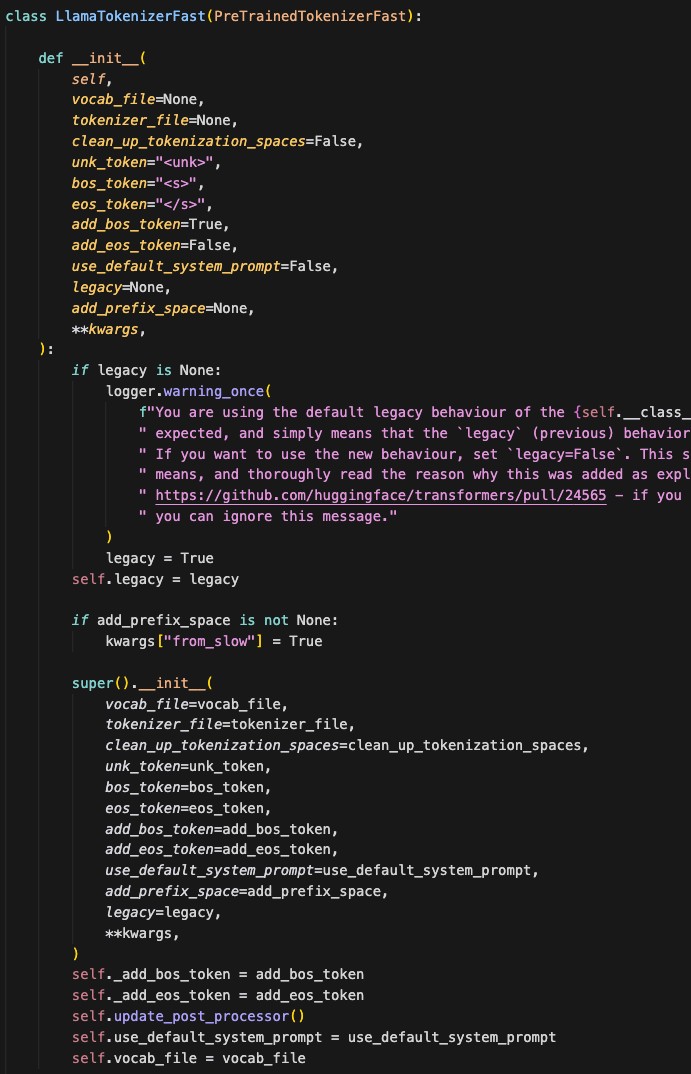
LlamaTokenizerFast as seen in v4 transformers
v4 also maintained two parallel implementations for every model:
a "slow" Python tokenizer (
LlamaTokenizerinheriting fromPreTrainedTokenizer) anda "fast" Rust-backed tokenizer (
LlamaTokenizerFastinheriting fromPreTrainedTokenizerFast).
This meant:
Two files per model (e.g.,
tokenization_llama.pyandtokenization_llama_fast.py)Code duplication across hundreds of models
Behavioral discrepancies between slow and fast versions, leading to subtle bugs
A growing test suite dedicated to verifying that slow and fast tokenizers produced identical outputs
User confusion about which tokenizer to use and when
Worst of all, you couldn't create an empty tokenizer architecture. If you wanted to train a LLaMA-style tokenizer on your own data, there was no clean way to instantiate a "blank" LLaMA tokenizer and fill it with your vocabulary and merges. Tokenizers existed only as loaded checkpoints, not as configurable templates.
The v5 solution: architecture and parameters are now separate
v5 treats tokenizer architecture (normalizer, pre-tokenizer, model type, post-processor, decoder) as distinct from trained parameters (vocabulary, merges). This mirrors how PyTorch separates model architecture from learned weights.
With nn.Module, you define layers first:
from torch import nn

model = nn.Sequential(
    nn.Embedding(vocab_size, embed_dim),
    nn.Linear(embed_dim, hidden_dim),
)
# Architecture defined; weights initialized randomly or loaded later
V5 tokenizers follow the same pattern:
from transformers import LlamaTokenizer

# Instantiate the architecture
tokenizer = LlamaTokenizer()

# Train on your own data to fill in vocab and merges
tokenizer.train(files=["my_corpus.txt"])
The tokenizer class now explicitly declares its structure. Looking at LlamaTokenizer in v5, you can immediately see:
It may add a prefix space before text
Its special tokens (
unk,bos,eos) sit at specific vocabulary positionsIt does not normalize input text
Its decoder replaces the metaspace character
▁with spaces
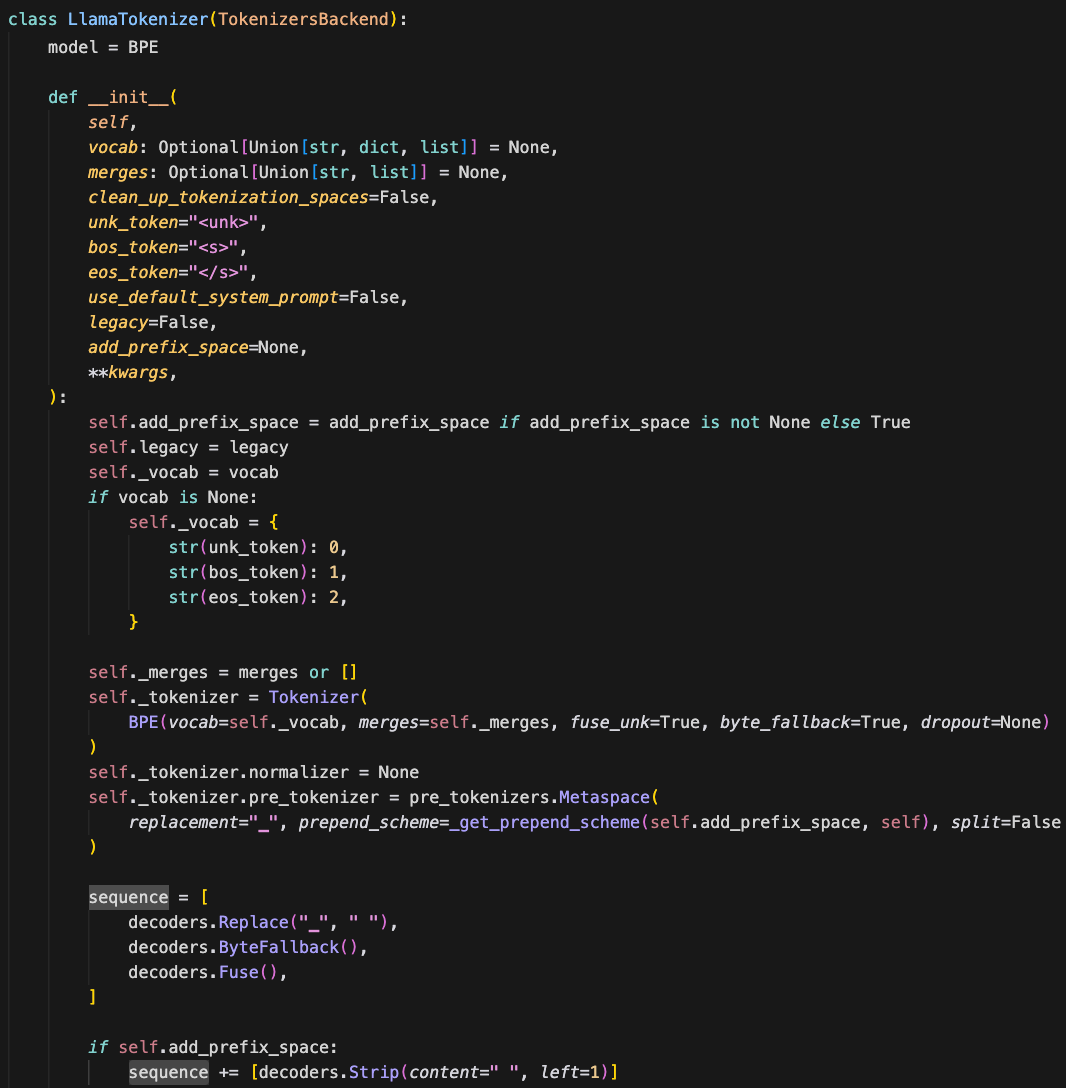
LlamaTokenizer as seen in v5 transformers
This transparency was impossible in v4, where the same information was buried in serialized files.
One file, one backend, one recommended path
v5 consolidates the two-file system into a single file per model. LlamaTokenizer now inherits from TokenizersBackend, which wraps the Rust-based tokenizer that was previously exposed as the “fast” implementation and is now the default.
The former “slow” Python implementation lives explicitly behind PythonBackend, and SentencePieceBackend remains for models that require it, but Rust-backed tokenization is the preferred default.
This change eliminates:
Duplicate code across slow/fast implementations
The confusing
TokenizervsTokenizerFastnaming conventionTest suites dedicated to checking slow-fast parity
Users now have one clear entry point. Advanced users who need to customize can still access lower-level components, but the library no longer forces everyone to navigate two parallel implementations.
You can now train model specific tokenizers from scratch
Suppose you want a tokenizer that behaves exactly like LLaMA's – same normalization, same pre-tokenization, same BPE model type – but trained on a domain-specific corpus (medical text, legal documents, a new language). In v4, this required manually reconstructing the tokenizer pipeline from low-level tokenizers library primitives. In v5, you can instantiate the architecture directly and call train:
from transformers import LlamaTokenizer
from datasets import load_dataset

# Initialize blank tokenizer
tokenizer = LlamaTokenizer()

dataset = load_dataset("wikitext", "wikitext-2-raw-v1", split="train")

def get_training_corpus():
    batch = 1000
    for i in range(0, len(dataset), batch):
        yield dataset[i : i + batch]["text"]

trained_tokenizer = tokenizer.train_new_from_iterator(
    text_iterator=get_training_corpus(),
    vocab_size=32000,
    length=len(dataset),
    show_progress=True,
)

trained_tokenizer.push_to_hub("my_custom_tokenizer")

tokenizer = LlamaTokenizer.from_pretrained("my_custom_tokenizer")
The resulting tokenizer will have your custom vocabulary and merge rules, but will process text identically to how a standard LLaMA tokenizer would with the same whitespace handling, same special token conventions, same decoding behavior.
Aspect
V4
V5
Files per model
Two (tokenization_X.py, tokenization_X_fast.py)
One (tokenization_X.py)
Default backend
Split between Python and Rust
Rust (TokenizersBackend) preferred
Architecture visibility
Hidden in serialized files
Explicit in class definition
Training from scratch
Required manual pipeline construction
tokenizer.train(files=[...])
Component inspection
Difficult, undocumented
Direct properties (tokenizer.normalizer, etc.)
Parent classes
PreTrainedTokenizer, PreTrainedTokenizerFast
TokenizersBackend (or SentencePieceBackend, PythonBackend)
The shift from "tokenizers as loaded checkpoints" to "tokenizers as configurable architectures" makes the library more modular, more transparent, and more aligned with how practitioners think about building ML systems.
Summary
Transformers v5 brings three improvements to tokenization:
One file per model instead of separate slow/fast implementations
Visible architecture so you can inspect normalizers, pre-tokenizers, and decoders
Trainable templates that let you create custom tokenizers matching any model's design
The wrapper layer between tokenizers and Transformers remains essential. It adds model awareness, context lengths, chat templates, special tokens, that raw tokenization doesn't provide. V5 just makes that layer clearer and more customizable.
If you are looking to learn more about tokenization here are some resources: