Thinking of ACE? We Can Do It with Fewer Tokens
ALTK-Evolve and ACE both let an agent learn from its own trajectories. The difference is what they do with what they learn — and that decides the token bill.
Give an LLM agent a realistic multi-step task — split a bill, find a song, reconcile an order across nine simulated apps — and when it fails, it usually isn't for lack of knowledge. It mis-paginates an API, resolves the wrong person, or returns a value when none was asked for. The model knows the APIs; what it hasn't internalized is how to use them reliably. That's learnable from the agent's own history.
Two recent systems do exactly this, on the same kind of agent: ACE (Agentic Context Engineering) and our ALTK-Evolve (introduced here). Both are a form of agentic memory — turning an agent's past trajectories into reusable lessons and feeding them back at inference time, no weight updates, no human labels. They even agree on the hard part. Where they part ways is delivery.
A note on words, because the two systems name things differently: we'll call the raw thing an agent learns a lesson. ACE organizes its lessons into one comprehensive, evolving playbook; we consolidate ours into individually retrievable guidelines. Same lessons, two containers.
What we agree on
Both systems refuse to compress.
ACE names the failure modes precisely: brevity bias — optimization collapsing toward short, generic instructions — and context collapse — a model asked to rewrite its whole context each step summarizing the detail away. Its answer is to keep a rich, itemized playbook, with a helpful/harmful counter on every bullet, and let the model distill relevance at read time.
We reach the same conclusion from the other direction. Every distinct guideline keeps a support count — how many independent episodes produced it — and we never summarize the store down to a handful of rules. A lesson five different tasks discovered is a different object from one that appeared once, and both are worth keeping.
So on the core question — should you compress an agent's hard-won lessons into a tidy summary? — ACE and ALTK-Evolve give the same answer: no. Count them, don't collapse them. ACE's per-bullet counters and our support counts are two spellings of the same idea.
Where we differ
Two places: how the memory is built, and how it's delivered — and it's the delivery difference that shows up in the token bill.
Consolidation (how the store is built). ACE grows one playbook through a Generator → Reflector → Curator loop, applying incremental delta updates and de-duplicating by embedding. We cluster near-duplicate lessons and merge within a cluster, support-conserving — when several lessons merge, the survivor inherits their combined count, so the store shrinks without losing the record of how much experience backs each guideline. We also extract typed guidelines — strategy, recovery, and optimization — with causal attribution and provenance back to the source trajectory, and at subtask granularity, so a lesson learned on one app can transfer to another.
Delivery (what reaches the model at inference). This is the one that drives the numbers. ACE injects the comprehensive playbook on every step, the same way regardless of model or task. We treat delivery as a dial, not a constant: a small fixed core of high-support guidelines, extended per task with a handful selected for the task at hand (cosine or LLM-guided, priority-weighted) — or, when a model has the headroom to use it, the full consolidated set. The same lessons are available to both agents; the difference is that ACE always sends all of them, and we send however many a given model can actually use.
Why it matters
On AppWorld, with the same base ReAct agent, running both systems in-house:
Model
TGC / SGC
Tokens/task
DeepSeek-V3.2
80.4 / 73.2
634K
ALTK-Evolve
89.3 / 80.4
263K
gpt-oss-120b
54.8 / 35.7
777K
ALTK-Evolve
56.0 / 37.5
116K
On the strong model we're better on both metrics at ~40% of ACE's inference cost. On the weak model we edge ACE 56.0 to 54.8 — close enough that we call it a tie on accuracy (a repeat run of ours landed at 54.8, matching ACE almost exactly, which is within this benchmark's run-to-run noise) — at about one-seventh the cost.
A fair word on cost: ACE's own efficiency story is about building its context cheaply. Ours is on a different axis — serving it. Retrieving a few guidelines per task instead of injecting the whole playbook on every step is where the tokens go, and it's the direct consequence of the delivery difference above.
Where does the accuracy come from? The by-difficulty breakdown tells two different stories:
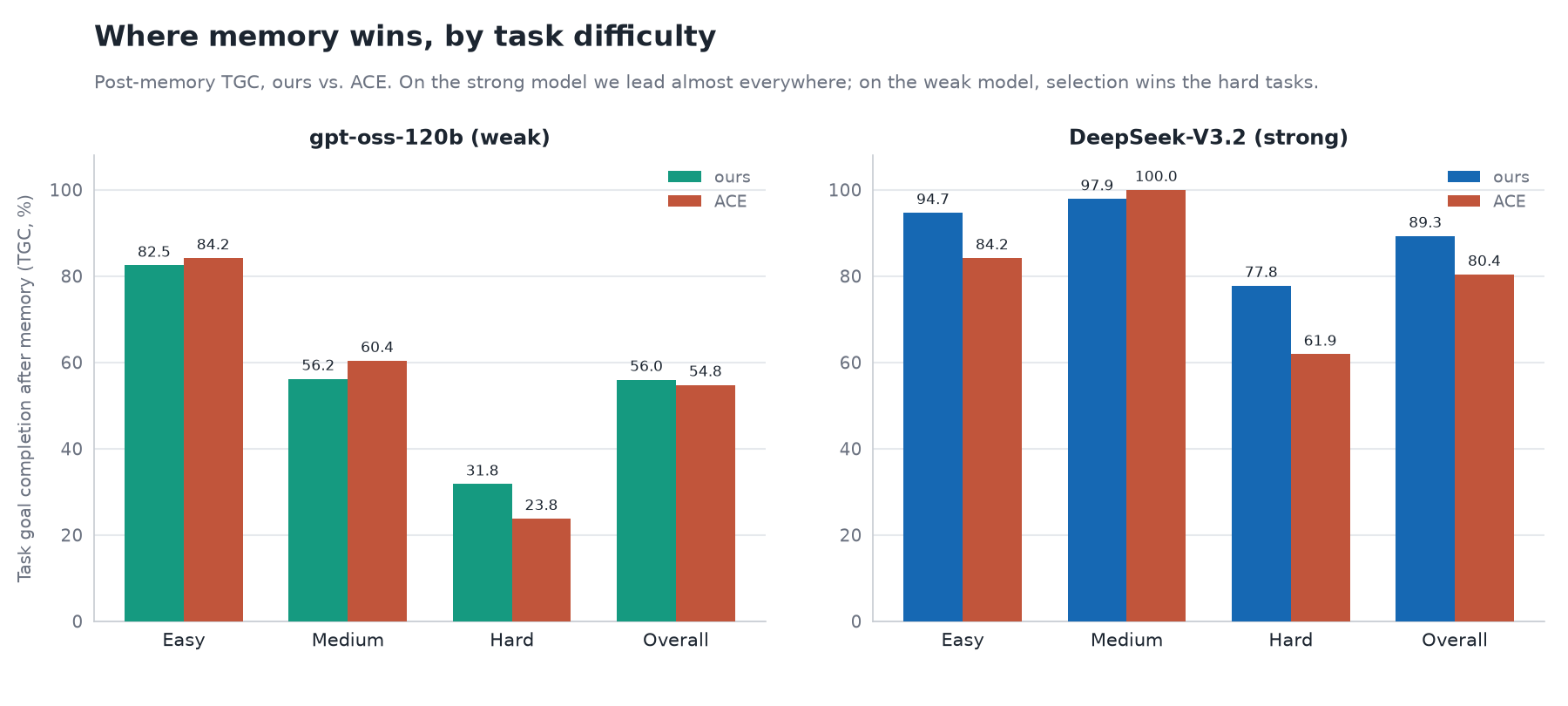
Figure 1. Post-memory Task Goal Completion by difficulty, ours vs. ACE. On DeepSeek-V3.2 (right) we win Easy, Hard, and Overall; ACE only edges Medium. On gpt-oss-120b (left) ACE leads easy and medium, but per-task selection wins the hard tasks — and the aggregate. Each system improves from its own no-memory baseline (see the by-difficulty reference tables under Method notes below).
We give each model its best configuration — the full consolidated set for the strong model, selective retrieval for the weaker one, because a large context overwhelms a weaker model rather than helping it. (Exactly how much to inject, and how it scales across the capability spectrum, is the focus of our follow-up post.)
Same lessons, different delivery
Both systems refuse to compress an agent's hard-won experience into a tidy summary — that part, we agree on. The difference is whether delivery is fixed or calibrated: ACE sends the whole playbook every step no matter what; we send however much of the guideline set a given model can actually use. That calibration is what bought the numbers above — same-or-better accuracy at a fraction of ACE's inference cost — and on the weaker model, it was the difference between guidance that helped and guidance that got in the way.
Try the ALTK-Evolve library — which includes the extraction, consolidation, and retrieval pipeline used here — or read the full technical report for the complete method and ablations.
Linked artifacts / references
Earlier post: ALTK-Evolve introduction — link
ACE (Agentic Context Engineering) — link
AppWorld benchmark — link
ALTK-Evolve — link
Full technical report — link
Method notes
AppWorld test_normal, 168 tasks. A ReAct code agent (each step writes Python; the environment returns the output). TGC = Task Goal Completion; SGC = Scenario Goal Completion, which requires every variant of a scenario to pass. Memory is mined from train/dev only; results are single runs (pass@1), as is standard on this benchmark.
The ACE numbers are our own runs of the ACE agent, evaluated in-house on the same AppWorld splits and the same base models as ALTK-Evolve (DeepSeek-V3.2 and gpt-oss-120b). The ACE paper reports on a different base model (DeepSeek-V3.1), so running it ourselves keeps the comparison controlled for model and harness. Both systems are the same ReAct agent and differ only in the prompt template — which is why the two no-memory baselines differ (72.0 vs 79.8 TGC); we don't rest the comparison on that baseline gap, only on the claims a prompt tweak can't touch: same-or-better accuracy at a fraction of the tokens.
Reference tables
DeepSeek-V3.2 — test_normal (168 tasks):
System
Guidelines
TGC
SGC
Tokens/task
ReAct, no memory
0
79.8
64.3
148K
ReAct + ACE
106
80.4
73.2
634K
ReAct + ALTK-Evolve
191
89.3
80.4
263K
gpt-oss-120b — test_normal:
System
Guidelines
TGC
SGC
Tokens/task
ReAct, no memory
0
39.9
21.4
110K
ReAct + ACE
full
54.8
35.7
777K
ReAct + ALTK-Evolve (selected)
~29
56.0
37.5
116K
gpt-oss-120b — by difficulty (TGC):
Difficulty
Baseline
ALTK-Evolve
Easy
66.7
84.2
82.5
Medium
35.4
60.4
56.2
Hard
19.1
23.8
31.8
Aggregate
39.9
54.8
56.0
DeepSeek-V3.2 — by difficulty (baseline → +memory): the two systems start from different no-memory baselines (79.8 vs 72.0 TGC overall) because of the prompt-template difference above.
Tier
ALTK TGC
ALTK SGC
ACE TGC
ACE SGC
Overall
79.8 → 89.3
64.3 → 80.4
72.0 → 80.4
57.1 → 73.2
Easy
93.0 → 94.7
84.2 → 84.2
78.9 → 84.2
63.2 → 78.9
Medium
81.2 → 97.9
62.5 → 93.8
85.4 → 100.0
75.0 → 100.0
Hard
66.7 → 77.8
47.6 → 66.7
55.6 → 61.9
38.1 → 47.6