Jupyter X Hugging Face
From serving as an essential learning resource to being a key tool used for model development, Jupyter notebooks have become a key component across many areas of machine learning. Notebooks' interactive and visual nature lets you get feedback quickly as you develop models, datasets, and demos. For many, their first exposure to training machine learning models is via a Jupyter notebook, and many practitioners use notebooks as a critical tool for developing and communicating their work.
What have we changed?
Under the hood, Jupyter notebook files (usually shared with an ipynb extension) are JSON files. While viewing these files directly is possible, it's not a format intended to be read by humans. We have now added rendering support for notebooks hosted on the Hub. This means that notebooks will now be displayed in a human-readable format.
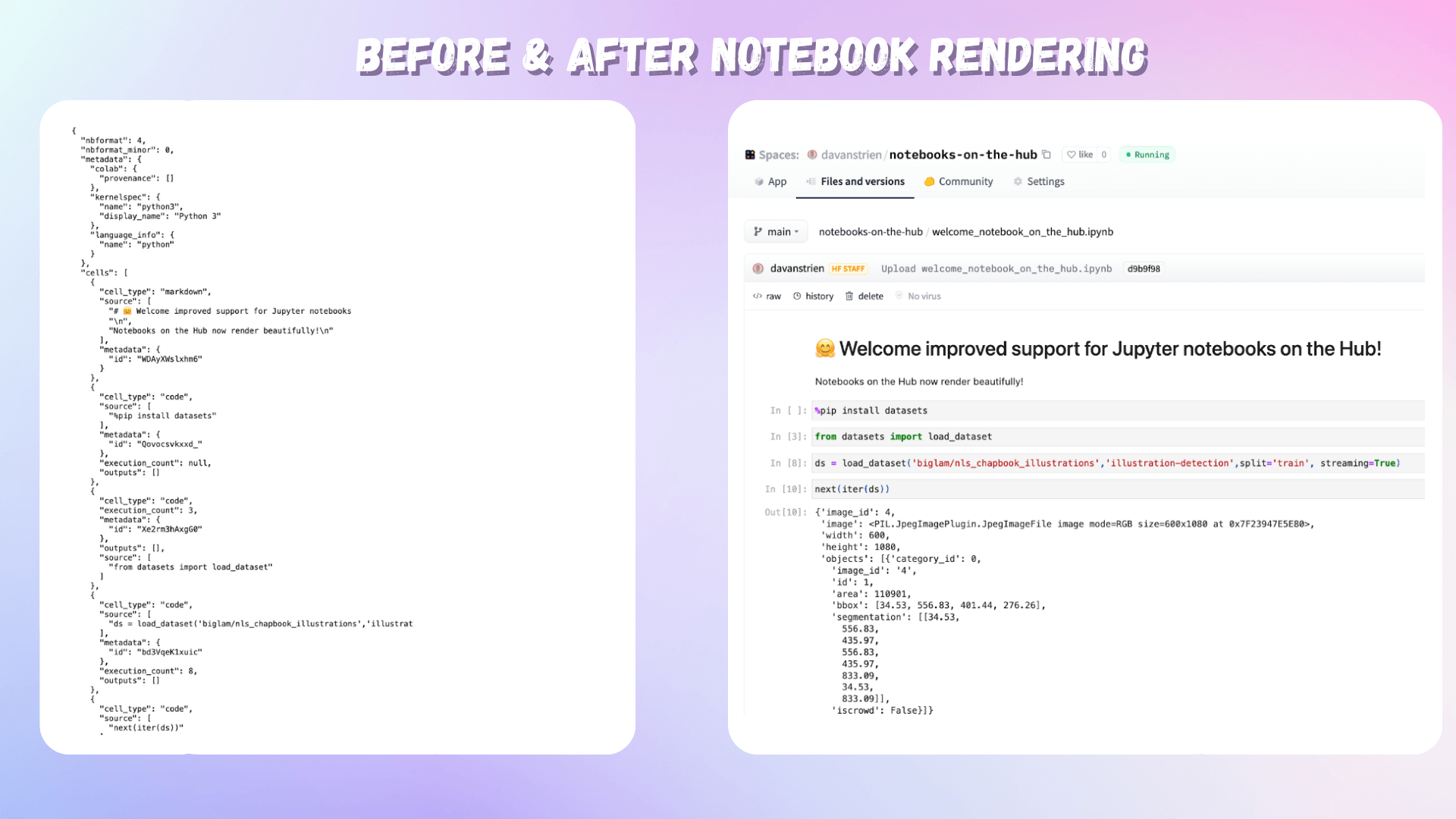
Before and after rendering of notebooks hosted on the hub.
Why are we excited to host more notebooks on the Hub?
Notebooks help document how people can use your models and datasets; sharing notebooks in the same place as your models and datasets makes it easier for others to use the resources you have created and shared on the Hub.
Many people use the Hub to develop a Machine Learning portfolio. You can now supplement this portfolio with Jupyter Notebooks too.
Support for one-click direct opening notebooks hosted on the Hub in Google Colab, making notebooks on the Hub an even more powerful experience. Look out for future announcements!