Granite 4.1 LLMs: How They’re Built
An in-depth technical walkthrough of data engineering, pre-training, supervised fine-tuning, and reinforcement learning behind the Granite 4.1 LLMs.
Authors: Granite Team, IBM
TL;DR — Granite 4.1 is a family of dense, decoder‑only LLMs (3B, 8B, and 30B) trained on ~15T tokens using a multi‑stage pre‑training pipeline, including long‑context extension of up to 512K tokens. The models are further refined with supervised fine‑tuning on ~4.1M high‑quality curated samples and reinforcement learning via on‑policy GRPO with DAPO loss (Yu et al., 2025). Notably, the 8B instruct model matches or surpasses the previous Granite 4.0‑H‑Small (32B‑A9B MoE) despite using a simpler dense architecture with fewer parameters. All Granite 4.1 models are released under the Apache 2.0 license.
Links:
Overview
Building high‑quality small language models goes beyond simply scaling compute—it requires rigorous data curation throughout training. For Granite 4.1, we prioritized data quality over quantity, progressively refining the data mixture across five pre‑training stages. We further curated supervised fine‑tuning data using an LLM‑as‑Judge framework and applied a multi‑stage reinforcement learning pipeline to systematically strengthen performance in math, coding, instruction following, and general chat.
Model Architecture
Granite 4.1 models use a decoder-only dense transformer architecture. The core design choices include Grouped Query Attention (GQA), Rotary Position Embeddings (RoPE), SwiGLU activations, RMSNorm, and shared input/output embeddings.
Component
3B Dense
8B Dense
30B Dense
Embedding size
2560
4096
4096
Number of layers
40
40
64
Attention head size
64
128
128
Number of attention heads
40
32
32
Number of KV heads
8
8
8
MLP hidden size
8192
12800
32768
MLP activation
SwiGLU
SwiGLU
SwiGLU
Position embedding
RoPE
RoPE
RoPE
All three model sizes share the same training pipeline and data strategy, differing only in architecture dimensions.
Pre-Training
Granite 4.1 is trained from scratch on approximately 15 trillion tokens using a five‑phase training strategy. Phases 1–2 focus on foundational pre‑training, phases 3–4 perform mid‑training with progressively higher‑quality data annealing, and phase 5 introduces long‑context training, extending the context window to 512K tokens. Each phase employs a distinct data mixture and learning‑rate schedule, gradually shifting from broad web‑scale data to more curated, domain‑specific content.

Figure 2: The five-phase pre-training pipeline. Phases 1–2 are pre-training, Phases 3–4 are mid-training (high-quality data annealing), and Phase 5 is long context training (LCE).
Phase 1: General Pre-Training (10T tokens)
The first phase establishes broad language understanding using a general mixture of training data with a power learning rate schedule and warmup.
Data composition:
CommonCrawl ~59% — general web data
Code ~20% — programming languages and repositories
Math ~7% — mathematical reasoning data
Technical ~10.5% — scientific papers, technical documentation and manuals
Multilingual ~2% — non-English language data
Domain Specific ~1.5% — domain-specific content
Phase 2: Math/Code Pre-Training (2T tokens)
Phase 2 sharply increases the proportion of code and mathematical data, pivoting toward stronger reasoning capabilities while still maintaining general language coverage.
Data composition:
Math ~35% — a 5x increase over Phase 1
Code ~30% — a 1.5x increase
CommonCrawl-HQ ~12% — high-quality common crawl subset
Synthetic ~9% — synthetic high-quality data
Technical ~10%
Multilingual ~3%
Domain ~1%
Phase 3: High-Quality Data Annealing (2T tokens)
Phase 3 transitions into mid-training with a more balanced, high-quality mixture and an exponential decay learning rate schedule. This is where we start blending in chain-of-thought and synthetic instruction data.
Data composition:
CommonCrawl-HQ ~16.67%
Math ~16.67%
Code ~16.67%
Synthetic ~8.5%
Technical ~12.5%
Multilingual ~4.5%
Long Chain-of-Thought ~12.5% — reasoning trajectories
Language Instructions ~7.5% — instruction tuning data
Code Instructions ~4.5% — instruction tuning data
Phase 4: High-Quality Data Annealing — Refinement (0.5T tokens)
The fourth phase continues mid-training with a linear learning rate decay to zero, focusing the model on the highest-quality data available.
Data composition:
CommonCrawl-HQ ~40%
Code ~20%
Math ~20%
Long Chain-of-Thought ~6%
Code Instructions ~5%
Language Instructions ~9%
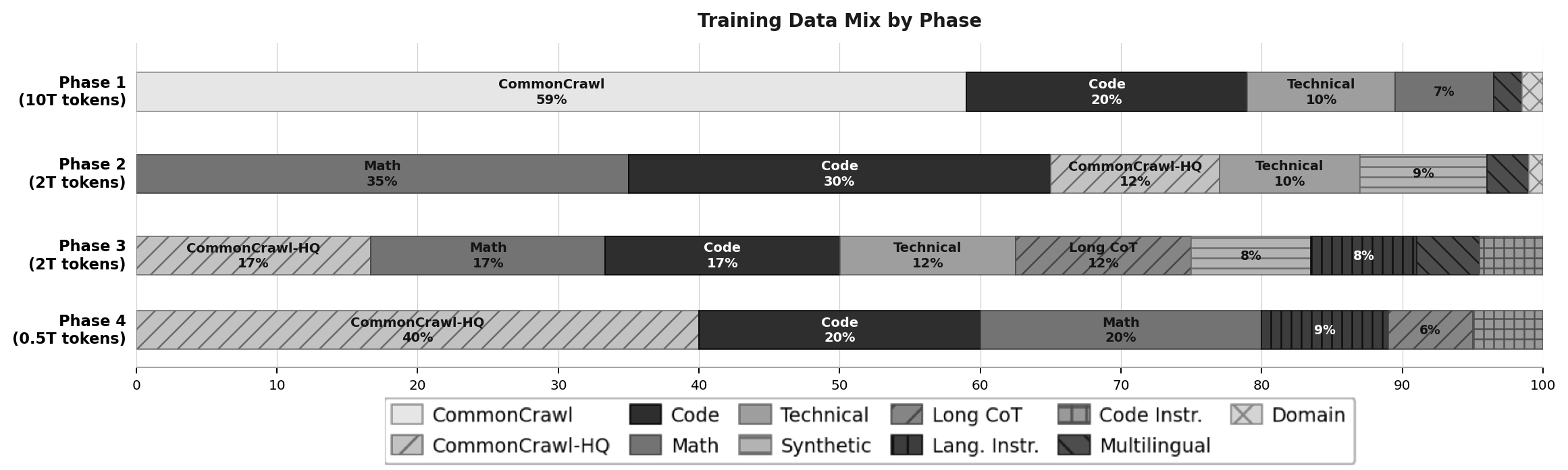
Figure 3: How the data mix evolves across the pre-training phases. Notice the progressive shift from web-heavy (Phase 1) to quality-heavy with instruction and reasoning data (Phases 3–4).
Phase 5: Long Context Training (LCE)
The fifth and final phase also part of of mid-training extends the context window from 4K to 512K through a staged long-context extension process:
32K extension — using the same data mix as Phase 4
128K extension — same data mix as Phase 4
512K extension — 80% books + 20% code repository data (8b and 30b only)
The LCE phase uses an exponential learning rate schedule starting at 1e-4 and decaying to 0. To ensure the model natively handles long sequences without degrading short-context performance, we do a model merge after each LCE stage. RULER benchmark of base models:
Model name
32K
64K
128K
granite-4.1-3b-base
75.0
66.6
58.0
granite-4.1-8b-base
83.6
79.1
73.0
granite-4.1-30b-base
85.2
84.6
76.7
SFT: Data Preparation & Quality Control
Supervised fine‑tuning (SFT) is what turns the base model into a reliable instruction‑following assistant, making data quality critically important—since even a small number of incorrect or hallucinated samples can instill undesirable behaviors. To address this, we apply a rigorous LLM‑as‑Judge framework alongside rule‑based filtering to curate high-quality samples. Together, the pipeline automatically assess each sample against structural, semantic, and behavioral criteria, fixing issues when possible and filtering out samples that fail to meet our quality standards.
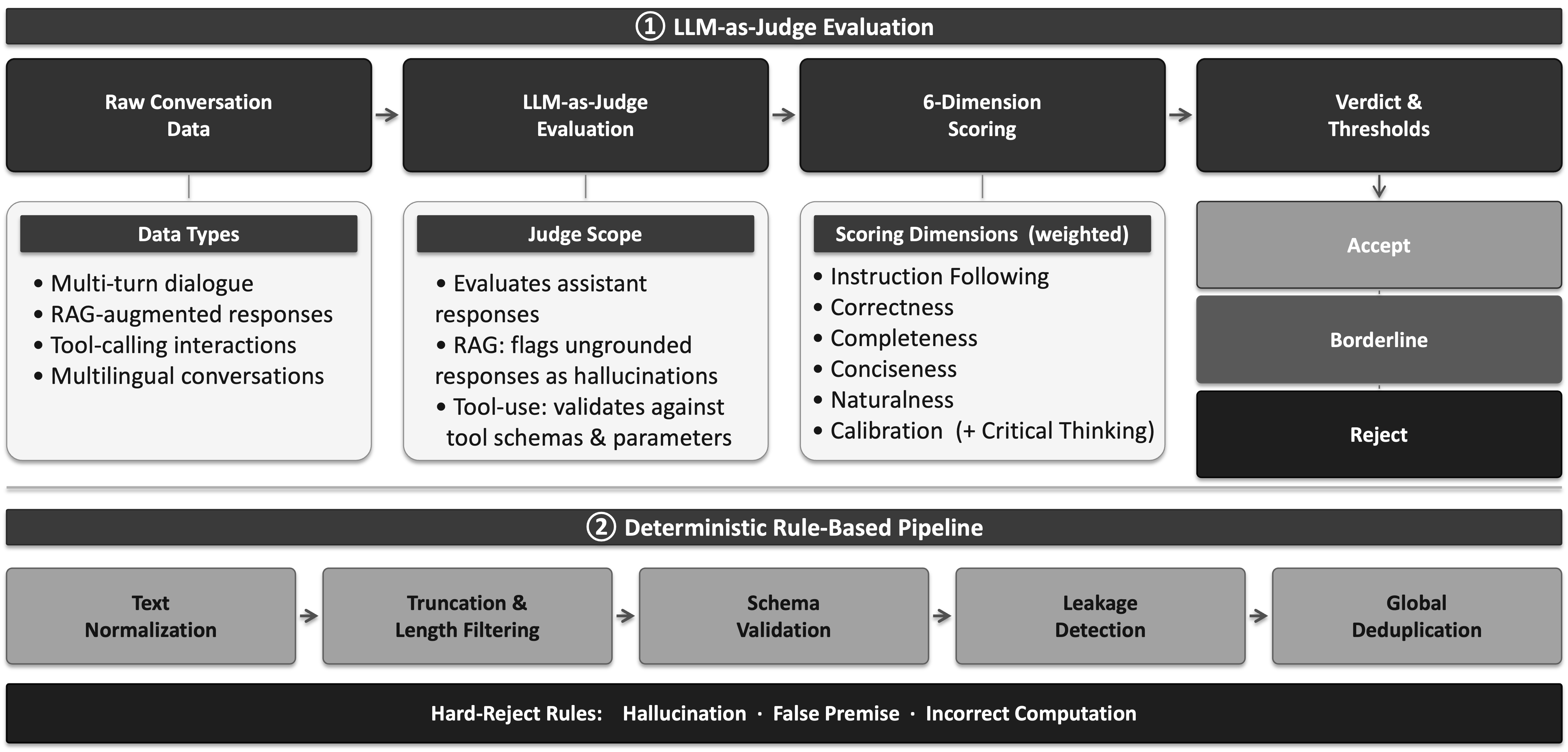
Figure 4: The SFT data quality pipeline. Raw conversation data passes through an LLM-as-Judge with a multi-dimensional rubric, producing accept/borderline/reject verdicts. Hard-reject defects (hallucination, false premise, incorrect computation) trigger automatic rejection regardless of score.
Our rigorous LLM‑as‑Judge framework evaluates only assistant responses, treating system prompts, user inputs, retrieved documents, and tool outputs strictly as contextual information. This ensures that the judge assesses what the model says, rather than what it was asked to do. In RAG settings, responses that are not grounded in the retrieved context are flagged as hallucinations, while tool‑use outputs are validated against the set of allowed tools and their parameter schemas.
We employ specialized judge prompts tailored to different SFT data types, including multi‑turn dialogue, RAG‑augmented responses, tool‑calling interactions, and multilingual conversations. Each response is scored across six weighted dimensions—instruction following, correctness, completeness, conciseness, naturalness, and calibration (with optional critical‑thinking checks). Samples are accepted, flagged as borderline, or rejected based on deterministic score thresholds, with hard‑reject rules overriding scores for severe defects such as hallucinations, false premises, or incorrect computations.
To complement semantic evaluation, we apply a deterministic rule‑based pipeline that enforces structural integrity through text normalization, truncation and length filtering, schema validation, and leakage detection. A final global deduplication step ensures dataset‑wide uniqueness. All filtering and correction actions are fully auditable.
SFT Training Details
After passing through the LLM-as-Judge, rule-based filtering, and global deduplication pipeline, we fine-tune base models on these approximately 4.1 million high-quality samples. The following details apply to all three model variants:
Training Configuration:
Parameter
Value
Compute
16 nodes, 4x GB200 per node
Epochs
3
Learning rate
5e-6 (linear warmup 3%, linear decay over ~25K steps)
Sequence length
16,384 tokens
Total samples
~4.1M
Effective batch size
256 samples/iter (~4.2M tokens/iter)
Reinforcement Learning: Multi-Stage RL Pipeline
After SFT, we apply a multi-stage reinforcement learning pipeline to further improve the model's capabilities across specific domains. Rather than a single RL pass, we run multiple targeted RL stages, each optimizing for different capabilities.
Training Methodology
We use On-policy GRPO (Group Relative Policy Optimization) (Shao et al., 2024) with DAPO (Decoupled Clip and Dynamic sAmpling Policy Optimization) loss (Yu et al., 2025) which provides more stable training signals compared to standard GRPO. However, due to computationally intensive nature of dynamic sampling, we switch it off during our training runs.
RL training configuration
Parameter
Value
Algorithm
On-policy GRPO with DAPO loss
Training stack
SkyRL (NovaSky-AI, 2025)
Samples per prompt
16
Train batch size
1024
Context length
8,192
RL Pipeline
Figure 10 depicts our Reinforcement Learning pipeline for training Granite 4.1 models. Through extensive experimentation with a variety of reinforcement learning recipes, we found that this sequence of steps minimizes catastrophic forgetting while simultaneously maximizing performance across multiple domains.
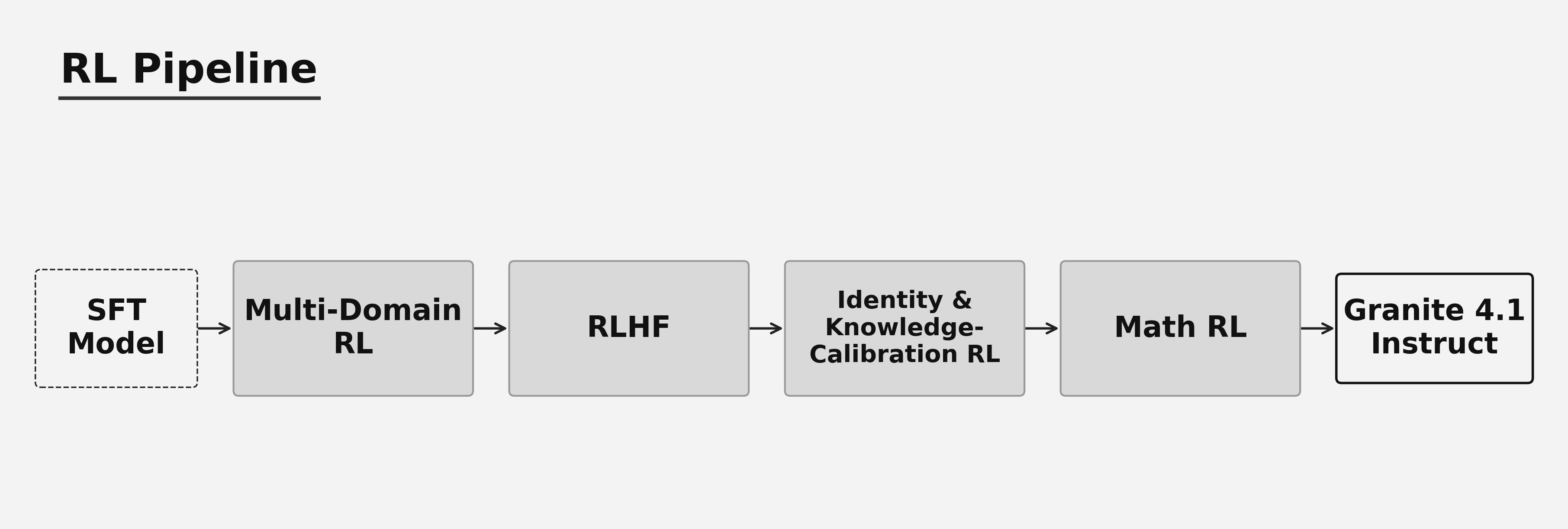
Figure 10: The Granite 4.1 reinforcement learning pipeline consisting of four sequential stages: Multi-domain RL, RLHF, Identity and Knowledge-calibration RL, and Math RL.
Multi-domain RL
In this stage, the model is trained jointly on a unified mixture of data drawn from multiple domains. Every gradient update therefore reflects the full diversity of tasks, which prevents catastrophic forgetting, boosts overall benchmark performance, and minimizes regressions on any individual task.
The different domains covered in this stage include:
Domain
Description
Math
Mathematical reasoning and computation
Science
Scientific knowledge and reasoning
Logical Reasoning
Deductive and inductive logic
Instruction Following (IF)
Adherence to complex instructions
Structured Output
Structured data output
Text2SQL
Database query generation
Temporal Reasoning
Time-based logic and ordering
General Chat
General conversational quality
In-context Learning
Learning from in-context examples
During this stage, we trained the models on 45,504 unique prompts (averaged across all Granite 4.1 models) and found that a learning rate of 5e‑7 with a KL‑loss coefficient ($\beta$) of 0.05 performed best for multi‑domain reinforcement learning.
RLHF
To further improve the model's helpfulness and chat ability, we train our model on generic-chat prompts using a multilingual scalar reward model. With this stage, we observed an average improvement of ~18.9 points (averaged across the three Granite 4.1 models) in Alpaca-Eval compared to the SFT checkpoints.
To mitigate policy drift from its previously learned knowledge, we use a conservative learning rate of 3e-7 and higher KL-loss coeff $\beta$ of 0.09 in this stage. We use an average of 17,920 unique prompts in this RLHF stage.
Identity & Knowledge-Calibration RL
In this stage, we train the model for a few steps (~40 training steps) on identity and knowledge calibration prompts. We observed that this small training stage significantly improves the model's self-identification capabilities.
Similar to the RLHF stage, we used a learning rate of 3e-7 and KL-loss coeff $\beta$ of 0.09, and we use 1728 unique prompts in this stage.
Math RL
During our RL training, we found that the RLHF stage causes a drop in math benchmark scores (e.g., in GSM8K, DeepMind-Math). The Math RL stage enables the model to recover from this drop and surpasses the original SFT performance on math benchmarks: ~3.8 points on average for GSM8K, and ~23.48 points on average for DeepMind-Math. We use an average of 13,504 unique prompts in this stage and similar to the multi-domain RL stage, we used a learning rate of 5e-7 and KL-loss coeff $\beta$ of 0.05.
Results
Base Model Benchmarks
Benchmark
Metric
3B
8B
30B
General Tasks
MMLU
5-shot
66.47
73.60
78.44
MMLU-Pro
5-shot, CoT
37.16
44.58
49.51
BBH
3-shot, CoT
63.84
73.83
80.66
AGI EVAL
3-shot
54.32
61.68
69.20
DROP
5-shot
66.04
72.36
78.57
Math Tasks
GSM8K
8-shot
72.93
73.54
83.78
Minerva Math
4-shot
38.00
43.42
45.66
Code Tasks
HumanEval
pass@1 (StarCoder)
76.19
79.24
81.52
HumanEval
pass@1
59.76
68.29
69.50
HumanEval+
pass@1
54.27
62.20
61.60
Eval+ Avg
65.94
62.05
63.90
Multilingual Tasks
MMMLU
5-shot
56.59
64.73
73.36
INCLUDE
5-shot
51.77
57.60
67.07
MGSM
8-shot
58.48
63.68
74.40
Instruct Model Benchmarks
Benchmark
Metric
3B
8B
30B
General Tasks
MMLU
5-shot
67.02
73.84
80.16
MMLU-Pro
5-shot, CoT
49.83
55.99
64.09
BBH
3-shot, CoT
75.83
80.51
83.74
AGI EVAL
0-shot, CoT
65.16
72.43
77.80
GPQA
0-shot, CoT
31.70
41.96
45.76
SimpleQA
3.68
4.82
6.81
Alignment Tasks
AlpacaEval 2.0
38.57
50.08
56.16
IFEval Avg
82.30
87.06
89.65
ArenaHard
37.80
68.98
71.02
MTBench Avg
7.53
8.50
8.53
Math Tasks
GSM8K
8-shot
86.88
92.49
94.16
GSM Symbolic
8-shot
81.32
83.70
75.70
Minerva Math
0-shot, CoT
67.94
80.10
81.32
DeepMind Math
0-shot, CoT
64.64
80.07
81.93
Code Tasks
HumanEval
pass@1
79.27
87.20
89.63
HumanEval+
pass@1
74.39
80.49
85.98
MBPP
pass@1
61.64
82.54
83.33
MBPP+
pass@1
52.91
70.64
71.69
CRUXEval-O
pass@1
40.75
47.63
55.75
BigCodeBench
pass@1
32.19
35.00
38.77
MULTIPLE
pass@1
52.54
60.26
62.31
Eval+ Avg
pass@1
67.05
80.21
82.66
Tool Calling
BFCL v3
60.80
68.27
73.68
Multilingual Tasks
MMMLU
5-shot
57.61
64.84
73.71
INCLUDE
5-shot
52.05
58.89
67.26
MGSM
8-shot
70.00
82.32
71.12
Safety
SALAD-Bench
93.95
95.80
96.41
AttaQ
81.88
81.19
85.76
Tulu3 Safety Eval Avg
66.84
75.57
78.19
Supported languages: English, German, Spanish, French, Japanese, Portuguese, Arabic, Czech, Italian, Korean, Dutch, and Chinese.
Granite 4.1 Comparison with Leading Open‑Source Models
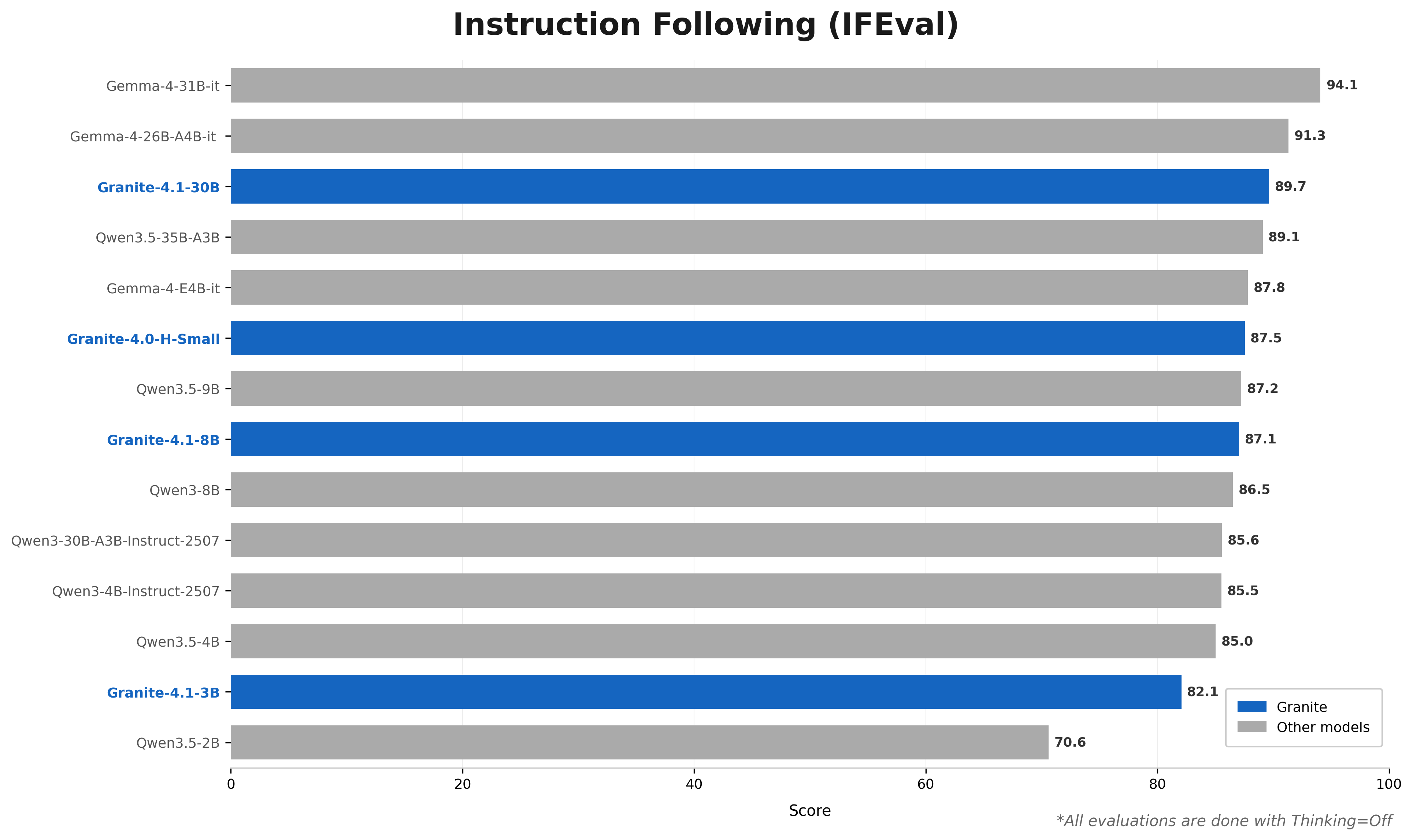
Granite 4.1 delivers competitive instruction‑following and tool‑calling capabilities without relying on long chains of thought. By avoiding extended reasoning traces, it provides predictable latency, stable token usage, and lower operational cost. This makes Granite 4.1 a production‑ready, open‑source choice for enterprise workloads where efficiency, reliability, and cost control are critical.
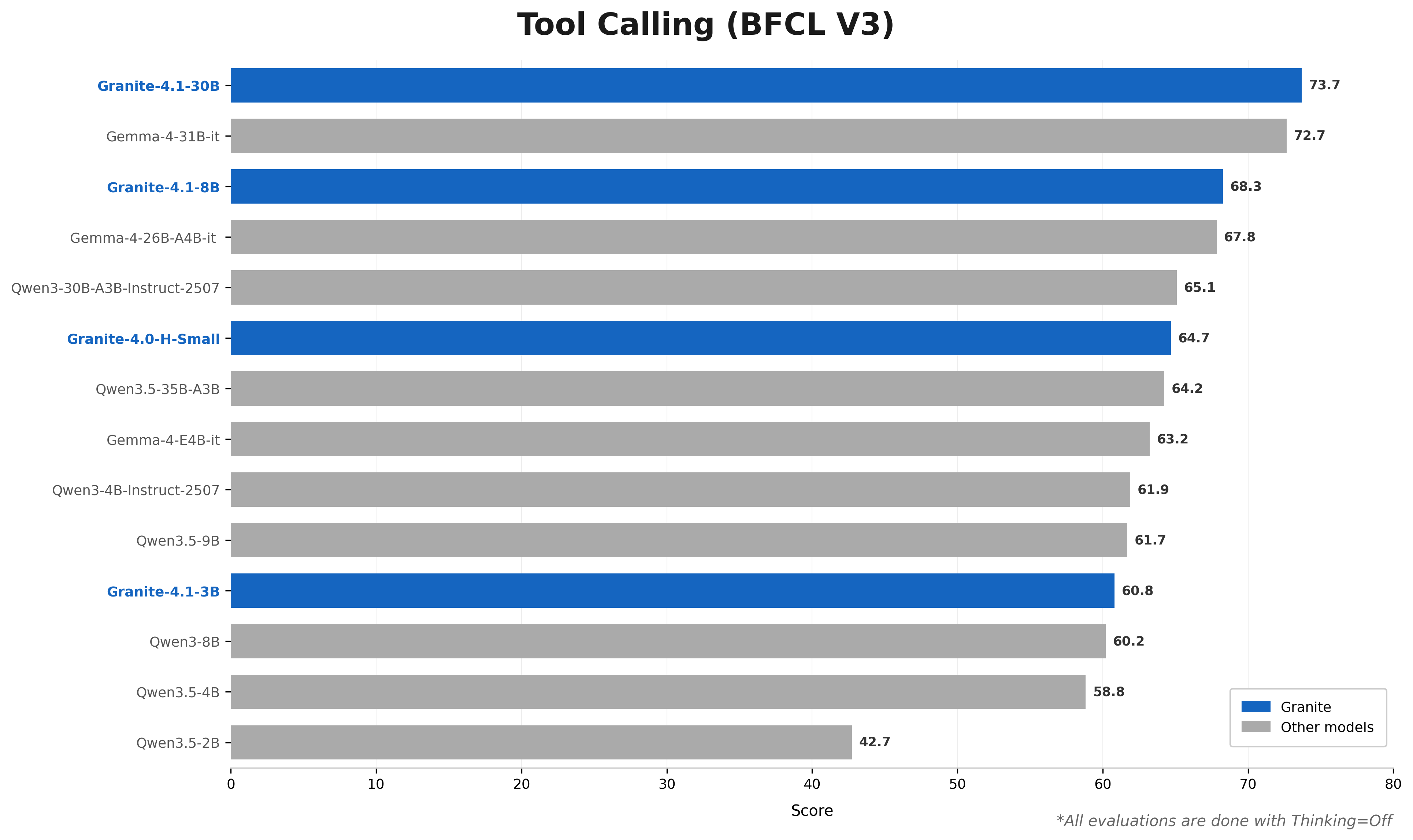
Granite 4.1-8B vs. Granite 4.0-H-Small (32B-A9B)
A striking result: the Granite 4.1-8B dense model consistently matches or outperforms the previous-generation Granite 4.0-H-Small, a 32B-parameter Mixture-of-Experts model with 9B active parameters.
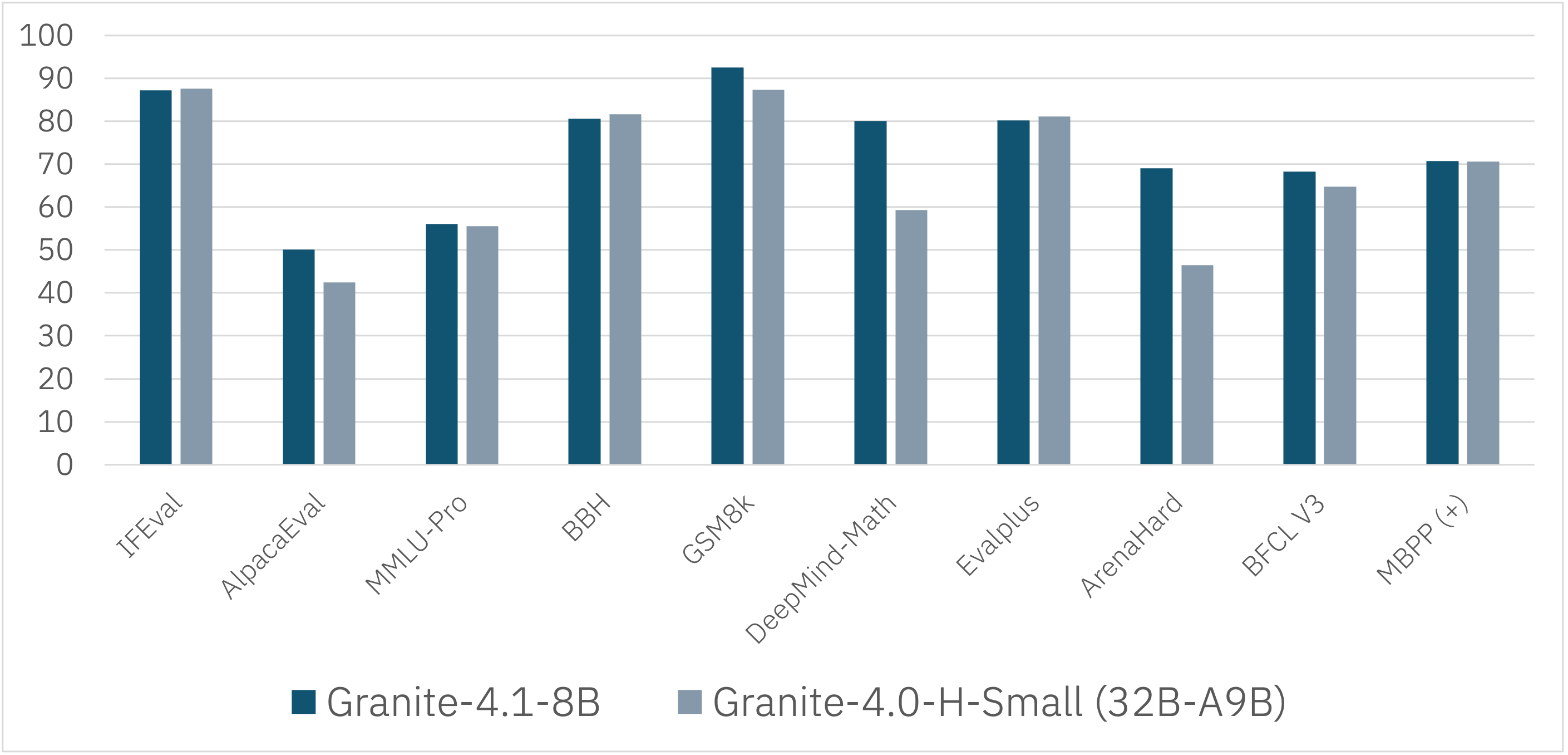
Figure 13: Granite 4.1-8B (dark blue) vs. Granite 4.0-H-Small 32B-A9B (light blue) across benchmarks. The 8B dense model matches or exceeds the larger MoE model on IFEval, AlpacaEval, MMLU-Pro, BBH, GSM8K, DeepMind-Math, Evalplus, ArenaHard, BFCL V3 and MBPP(+).
Granite 4.1 Model Family Comparison
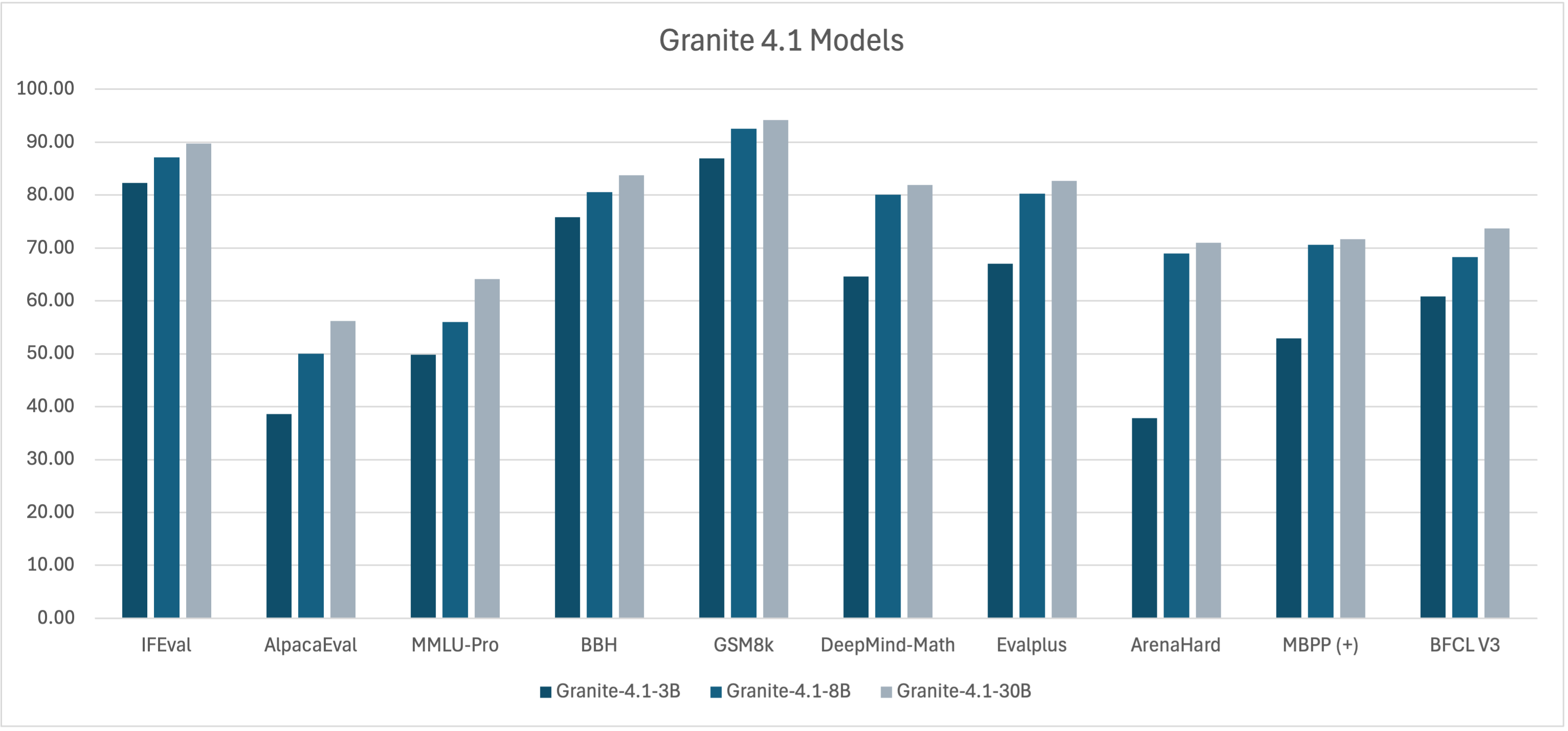
Figure 14: Comparison across the Granite 4.1 family — 30B, 8B, and 3B models. Scores scale predictably with model size, with the 30B model leading across all benchmarks.
FP8 Quantization
We also released fp8 quantized variants of the Granite 4.1 models, optimized for inference with vLLM. The precision is reduced from 16‑bit to 8‑bit, resulting in approximately a 50% reduction in both disk footprint and GPU memory usage. Quantization is applied only to the weights and activations of linear operators within the transformer blocks using LLM Compressor, while all other layers are preserved at their original precision.
Infrastructure
We trained the Granite 4.1 Language Models on an NVIDIA GB200 NVL72 cluster hosted on CoreWeave:
Intra-rack communication: 72-GPU NVLink domain
Inter-rack communication: Non-blocking, full Fat-Tree NDR 400 Gb/s InfiniBand network
Scale: Thousands of GPUs across the cluster
This infrastructure provides the scalable, high-bandwidth interconnect needed for efficient distributed training at the token volumes required (15T+ tokens across pre-training alone).
Getting Started
Granite 4.1 models are available under the Apache 2.0 license. Here's how to get started with the 30B instruct model wiht tool calling example:
pip install torch torchvision torchaudio
pip install accelerate
pip install transformers
import torch
from transformers import AutoModelForCausalLM, AutoTokenizer
device = "cuda"
model_path = "ibm-granite/granite-4.1-30b"
tokenizer = AutoTokenizer.from_pretrained(model_path)
# drop device_map if running on CPU
model = AutoModelForCausalLM.from_pretrained(model_path, device_map=device)
model.eval()
tools = [
{
"type": "function",
"function": {
"name": "get_current_weather",
"description": "Get the current weather for a specified city.",
"parameters": {
"type": "object",
"properties": {
"city": {
"type": "string",
"description": "Name of the city"
}
},
"required": ["city"]
}
}
}
]
# change input text as desired
chat = [
{ "role": "user", "content": "What's the weather like in London right now?" },
]
chat = tokenizer.apply_chat_template(chat, \
tokenize=False, \
tools=tools, \
add_generation_prompt=True)
# tokenize the text
input_tokens = tokenizer(chat, return_tensors="pt").to(device)
# generate output tokens
output = model.generate(**input_tokens,
max_new_tokens=100)
# decode output tokens into text
output = tokenizer.batch_decode(output)
# print output
print(output[0])Expected Output:
<|start_of_role|>system<|end_of_role|>You are a helpful assistant with access to the following tools. You may call one or more tools to assist with the user query.

You are provided with function signatures within <tools></tools> XML tags:
<tools>
{"type": "function", "function": {"name": "get_current_weather", "description": "Get the current weather for a specified city.", "parameters": {"type": "object", "properties": {"city": {"type": "string", "description": "Name of the city"}}, "required": ["city"]}}}
</tools>

For each tool call, return a json object with function name and arguments within <tool_call></tool_call> XML tags:
<tool_call>
{"name": <function-name>, "arguments": <args-json-object>}
</tool_call>. If a tool does not exist in the provided list of tools, notify the user that you do not have the ability to fulfill the request.<|end_of_text|>
<|start_of_role|>user<|end_of_role|>What's the weather like in London right now?<|end_of_text|>
<|start_of_role|>assistant<|end_of_role|><tool_call>
{"name": "get_current_weather", "arguments": {"city": "London"}}
</tool_call><|end_of_text|>
Resources:
Granite 4.1 marks a significant step forward for high‑quality, open‑source language models. By prioritizing data quality and rigor at every stage—from pre‑training curation to supervised fine‑tuning and multi‑stage reinforcement learning—we deliver a substantially improved post‑training pipeline. The result is stronger instruction following, tool use, and conversational performance, showing that carefully trained dense 8B models can rival much larger MoE architectures. We’re excited to see how the community adopts and builds on these models.