How a Hospital Management System Improves Patient Care and Operational Efficiency
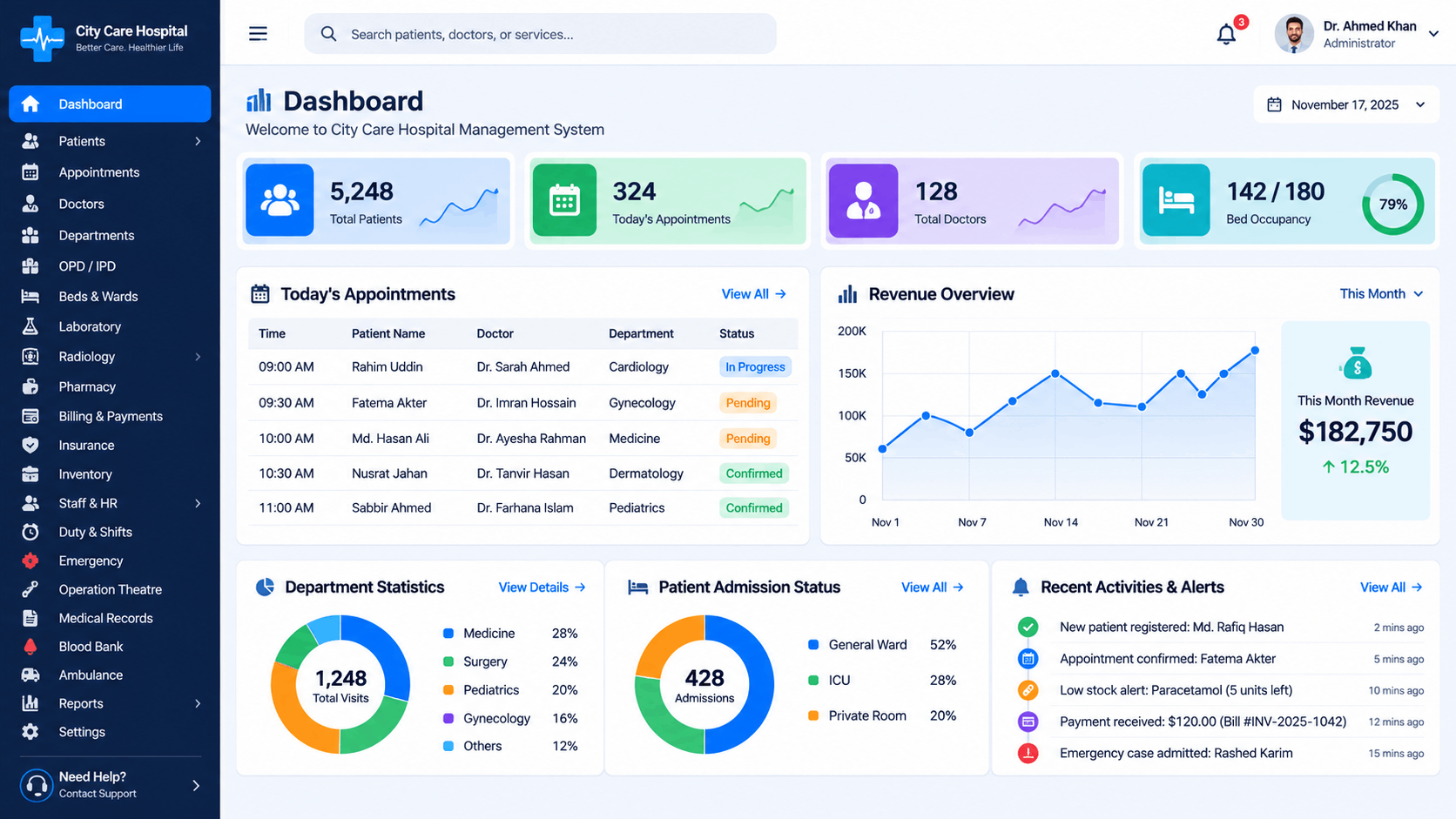
Modern hospitals handle hundreds of patients, appointments, medical records, doctors, laboratory tests, prescriptions, billing activities, and administrative tasks every day. Managing these operations manually can lead to delays, paperwork, communication gaps, and unnecessary complexity. A Hospital Management System (HMS) helps healthcare organizations bring their essential operations together through one centralized digital platform.
What Is a Hospital Management System?
A Hospital Management System is a web-based software solution designed to streamline hospital administration, patient care, and healthcare service management. It connects different hospital departments and allows authorized staff to access, manage, and update information more efficiently.
From patient registration and appointment scheduling to medical records, pharmacy inventory, billing, and hospital reports, an integrated HMS simplifies daily workflows and helps hospitals operate more smoothly.
Essential Features of a Hospital Management System
A modern hospital management application should include essential features that support patients, healthcare professionals, and hospital administrators.
Patient Management: Maintain patient profiles, personal information, medical history, diagnoses, treatment records, and documents in a centralized system.
Appointment Scheduling: Manage doctor availability, patient bookings, appointment calendars, cancellations, follow-ups, and daily consultation schedules.
Doctor and Staff Management: Organize doctor profiles, medical specializations, staff information, duty rosters, schedules, and departmental assignments.
Electronic Medical Records (EMR): Access patient histories, prescriptions, clinical notes, allergies, test results, and treatment plans digitally.
Laboratory and Pharmacy Management: Manage lab requests, test results, medicine inventory, prescriptions, stock levels, and dispensing records.
Billing and Payments: Generate invoices, track payments, manage outstanding bills, and organize financial records.
Reports and Analytics: Monitor patient visits, appointments, hospital performance, revenue, inventory, and operational activities through dashboards and reports.
Why Hospitals Need Digital Management Solutions
Healthcare organizations need more than basic record-keeping. They require connected systems that help departments communicate, reduce repetitive administrative work, and make important information accessible when needed.
A hospital management system can improve patient registration, reduce appointment scheduling conflicts, simplify billing, organize medical records, and support better resource management. Administrators can monitor hospital operations more effectively, while doctors and staff can spend less time handling paperwork and more time focusing on patient care.
A responsive interface also allows authorized users to access the system from desktops, tablets, and other devices, supporting more flexible hospital workflows.
Building a Hospital Management System with Productive IT BD
Developing a reliable hospital management system requires thoughtful planning, intuitive interface design, secure data management, and scalable software architecture. Every hospital has different workflows, departmental requirements, and operational challenges, making customization an important part of the development process.
Productive IT BD provides professional website, web application, software, mobile application, SaaS, API integration, and business automation development services to businesses looking for practical digital solutions.
Whether you are planning a hospital administration platform, a patient management application, a doctor appointment portal, or a complete healthcare management solution, the right development approach can turn your idea into a functional digital product.
Explore our development services: https://www.productiveitbd.com/
Connect with us on Freelancer.com: https://www.freelancer.com/u/mdshakilhasan04
Why Choose Professional Hospital Software Development?
A professionally developed hospital management application should prioritize security, performance, scalability, and user experience. Healthcare systems handle sensitive information, so proper authentication, access permissions, data protection, and reliable database design are essential.
Responsive design ensures usability across different screen sizes, while scalable architecture makes it easier to introduce additional modules, departments, integrations, and features as the organization grows.
A well-planned solution can support both current hospital operations and future digital transformation goals.
Conclusion
A Hospital Management System is an important step toward more organized, efficient, and digitally connected healthcare operations. By integrating patient management, appointments, medical records, pharmacy, laboratory, billing, and analytics, hospitals can simplify administrative workflows and improve accessibility to essential information.
If you are planning to build a healthcare website, hospital management application, or custom software for your organization, Productive IT BD can help turn your requirements into a modern digital solution designed around your business needs.