How Smart Vending Machines Are Transforming Modern Office Workplaces
Walk into a well-run office in 2025 and the break room looks a little different. That old snack machine with the flickering fluorescent light and the "exact change only" sign? It's quietly disappearing. In its place: a connected device that knows what's in stock, takes UPI or a tap of a card, and pings someone when it's running low on cold brew.
We build the hardware and firmware behind these machines, so we've watched this shift from the inside. A s isn't just a snack dispenser with a screen bolted on. There's real engineering underneath — and that's what makes it useful.
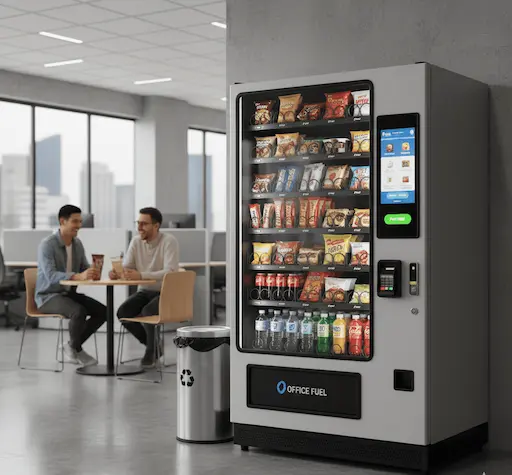
What actually makes a vending machine "smart"
Strip away the marketing and it comes down to three things: connectivity, sensing, and payment.
On connectivity, most of the machines we've worked on run either on the Nordic nRF52 series for BLE-based interactions or an ESP32 when Wi-Fi is the primary link. The nRF52 fits well when the machine needs to talk to a phone app for purchases or inventory checks — it's low power and the BLE stack is mature. The ESP32 handles the heavier lifting: MQTT to a cloud backend, OTA firmware updates, and a local web dashboard for the facilities team.
Sensing is where it gets interesting. Weight sensors under each shelf coil, infrared beam counters at the drop chute, temperature probes inside the refrigeration compartment. We've built boards that read all of these and push the data upstream every few minutes. If a motor fails to dispense, the machine knows before the customer complains.
Payment integration is the piece offices care about most. Cashless is table stakes now — card readers, UPI QR codes, and in some cases employee badge authentication so purchases get billed to a corporate account. We've done PCB designs in KiCad that integrate a secure element for payment processing alongside the main microcontroller, keeping the payment path isolated from the vending logic.
Why offices are adopting them
The obvious answer is convenience, but the real drivers are more practical.
Inventory visibility. Facilities teams used to find out a machine was empty when someone complained. With MQTT telemetry flowing to a dashboard, restocking becomes predictive. A machine in a 300-person office might dispense 40–60 items a day; knowing which SKUs move fastest lets the operator stock accordingly instead of guessing.
Reduced cash handling. Cash machines need emptying, counting, and reconciliation. Every one of those steps costs labor and introduces error. Going cashless removes that entirely, and in India, UPI adoption inside offices is high enough that a QR code on the machine gets used daily.
Subsidy and policy control. Larger employers often subsidize healthy items or cap unhealthy ones. A connected machine can enforce pricing rules per employee group, log every transaction, and generate reports. That's a firmware and backend problem, not a hardware one — but it's only possible because the machine is online.
The engineering behind a reliable machine
A vending machine lives in a hostile environment. It gets bumped, the compressor cycles, the room temperature swings, and it's expected to run for years with minimal attention. We design for that.
Our firmware runs on Zephyr RTOS for most of these builds. The reason is simple: we need deterministic task scheduling for motor control and sensor polling while also running a network stack. Zephyr gives us that without the overhead of a full Linux build. Motor drivers, sensor reads, and payment polling all run as separate threads with defined priorities, so a slow network response never causes a dispense failure.
On the PCB side, we keep power delivery clean. Vending machines draw peak current when multiple motors fire at once, and a poorly designed power stage will brown out the microcontroller mid-transaction. We've seen that failure mode in third-party boards and it's ugly: a customer pays, the motor stalls, and the machine reboots without dispensing. Careful decoupling and a proper ground plane fix it.
We handle the enclosure too. 3D design and mechanical prototyping matter here because the dispensing mechanism has to be reliable across thousands of cycles. A coil that jams once a week is a support ticket every week.
What to look for if you're specifying one
If your office is evaluating a smart vending machine, ask a few pointed questions:
What's the connectivity stack? BLE-only means limited remote management. Wi-Fi or cellular with MQTT is better for fleet operations.
How does it handle a failed dispense? There should be a sensor that confirms the product dropped and an automatic refund or retry path.
Is the firmware updatable remotely? OTA updates are non-negotiable for a device you'll run for five years.
What does the data look like? You want per-SKU sales, stock levels, and fault logs — not just a transaction count.
The answers separate a genuinely connected machine from one with a touchscreen and a card reader.
Where this is heading
The next step we're seeing is tighter integration with workplace systems. Badge-based purchases that tie into existing access control. Machines that adjust stock based on meeting room calendars — more coffee when there's an all-hands. Matter support so the machine reports status alongside other building IoT devices.
None of that requires exotic hardware. It requires a team that can design the board, write the firmware, and ship a working prototype. That's the work we do — from KiCad schematics through to a machine sitting in your lobby, dispensing correctly and reporting back.
If you're building a smart vending machine for office deployment, or you've got a prototype that needs to become a product, our team can help. We handle firmware, PCB design, 3D enclosure work, and full prototype shipping.